Most expensive home repairs do not start as expensive problems.
A roof leak may begin with a damaged shingle. A flooded basement may start with a clogged gutter. An HVAC failure may develop after months of restricted airflow. A plumbing repair can begin with a slow leak that nobody notices.
That is why home maintenance is less about keeping a house looking perfect and more about catching small failures before they become large ones.
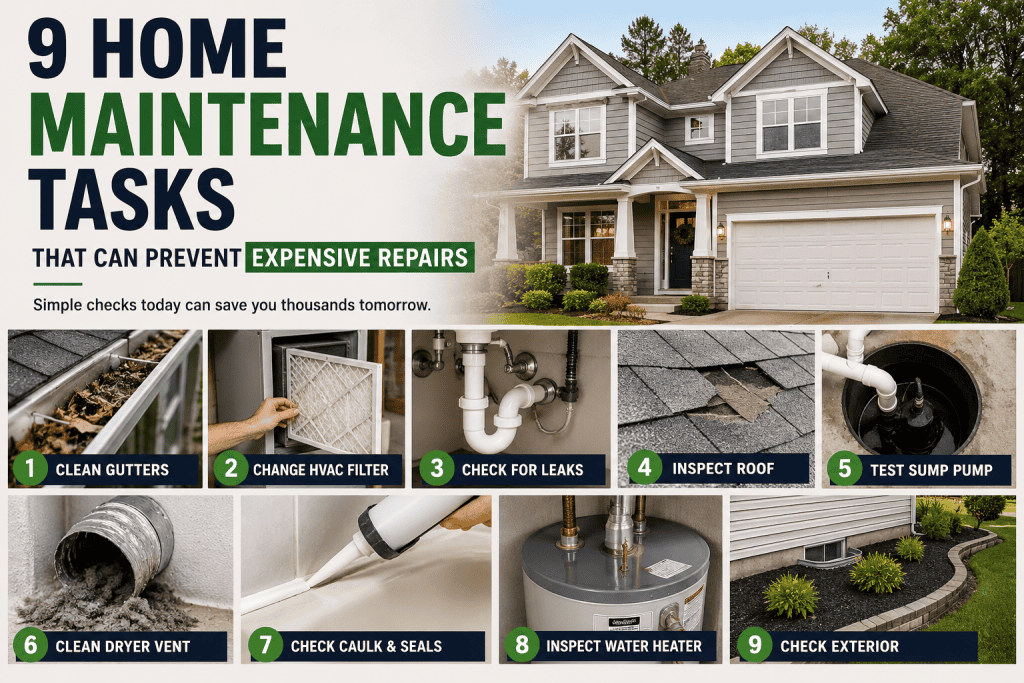
If you own a home, these nine maintenance tasks deserve priority because neglect can lead to significantly more costly damage later.
1. Clean Your Gutters and Check Downspouts
Gutters have one job: move rainwater away from your house.
When leaves, dirt, or debris block that flow, water can overflow and end up where you do not want it.
Potential consequences include:
- damaged fascia boards;
- water entering behind siding;
- foundation moisture;
- basement leaks;
- landscape erosion;
- ice-related problems in colder climates.
Cleaning gutters is therefore not primarily cosmetic maintenance.
It is part of your home’s water-management system.
What to check
Look for:
- standing water;
- overflowing sections;
- loose gutter fasteners;
- separated joints;
- damaged downspouts;
- water collecting near the foundation.
Downspouts should discharge water far enough away that it does not immediately flow back toward the house.
If water repeatedly pools next to the foundation after rain, the problem deserves attention even if the basement still appears dry.
2. Replace or Clean Your HVAC Filter
An HVAC filter that becomes heavily clogged can restrict airflow.
That forces the heating or cooling system to work harder and may contribute to:
- reduced comfort;
- higher energy use;
- frozen coils;
- excessive system strain;
- poor indoor air circulation.
How often a filter needs attention depends on the filter type, system, household, pets, dust levels, and usage.
Instead of relying blindly on a calendar, inspect it regularly.
A simple rule
If the filter is visibly loaded with dust and airflow appears restricted, do not wait simply because the recommended replacement date has not arrived.
Homeowners with:
- multiple pets;
- renovation dust;
- smokers;
- high HVAC use
may need to check filters more frequently.
A filter costs little compared with a major HVAC service call.
3. Look for Small Plumbing Leaks
A dramatic pipe burst is easy to notice.
A slow leak is more dangerous in another way: it can continue for weeks or months.
Check periodically under:
- kitchen sinks;
- bathroom vanities;
- toilets;
- washing-machine connections;
- refrigerators with water lines;
- water heaters.
Look for:
- moisture;
- staining;
- swollen cabinetry;
- corrosion;
- mold-like discoloration;
- unusual odors;
- dripping sounds.
Do not ignore water simply because the leak seems small.
The cost of fixing a connector, valve, seal, or supply line may be minor compared with replacing flooring, drywall, cabinets, or damaged structural materials.
4. Inspect Your Roof From the Ground
You do not necessarily need to climb onto the roof to notice developing problems.
From a safe location, look for:
- missing shingles;
- damaged flashing;
- sagging areas;
- debris accumulation;
- unusual discoloration;
- damaged gutters.
Inside the home, inspect ceilings and attic areas for signs such as:
- water stains;
- damp insulation;
- musty smells;
- daylight entering where it should not.
Roof problems tend to become much more expensive once water reaches the interior of the building.
If something looks wrong, professional inspection is generally safer than climbing onto the roof yourself.
5. Test Your Sump Pump
If your home relies on a sump pump, waiting until a major storm to discover that it has failed is a bad strategy.
Check that:
- the pump activates;
- water exits correctly;
- the discharge line is clear;
- the power supply is reliable;
- the pit is not obstructed.
Homes with significant basement-water exposure may also benefit from considering backup power or a secondary system.
A sump pump is unusual because it may sit unused for long periods and then suddenly become one of the most important pieces of equipment in the house.
That makes preventive testing particularly valuable.
6. Maintain the Dryer Vent
Cleaning the lint screen after each load is important, but it does not replace checking the dryer vent system.
Lint can accumulate in:
- vent ducts;
- elbows;
- exterior vent openings;
- areas behind the dryer.
Warning signs can include:
- clothes taking longer to dry;
- the dryer becoming unusually hot;
- weak airflow outside;
- a burning smell;
- excessive lint accumulation.
Restricted airflow also makes the dryer work harder.
Make sure the vent path remains clear and that the exterior flap can open properly while the machine is running.
7. Inspect Caulk and Seals Around Wet Areas
The line of caulk around a bathtub or sink may look insignificant.
Its purpose is not.
Damaged seals can allow water to travel behind surfaces where it remains unnoticed.
Check around:
- bathtubs;
- showers;
- sinks;
- backsplashes;
- windows exposed to moisture.
Watch for:
- gaps;
- cracking;
- peeling;
- discoloration;
- separation from the surface.
Resealing a small area is inexpensive.
Repairing water-damaged drywall, framing, cabinetry, or flooring is not.
8. Check Your Water Heater for Early Warning Signs
Water heaters often receive little attention until they stop producing hot water—or start leaking.
Inspect around the unit for:
- corrosion;
- moisture;
- unusual sounds;
- rust-colored water;
- damaged connections;
- signs of leakage.
Know where the water shutoff is located before an emergency occurs.
That information is surprisingly valuable if the tank develops a serious leak.
If you see water where there should not be water, investigate immediately rather than assuming it is harmless condensation.
9. Walk Around the Exterior of Your Home
One of the best maintenance tools costs nothing.
Walk around the house several times a year and actively look for changes.
Check:
- siding;
- foundation;
- windows;
- exterior doors;
- roof edges;
- drainage;
- trees near the structure;
- exterior faucets;
- decks and stairs.
You are looking for things that were not there before:
- new cracks;
- peeling material;
- standing water;
- rot;
- gaps;
- loose components;
- vegetation touching the building;
- soil erosion.
Homeowners often become accustomed to gradual deterioration because they see the house every day.
A deliberate inspection forces you to look at it differently.
The Maintenance Priority Rule
Not every maintenance task deserves equal urgency.
Prioritize anything involving:
Water
because water damage can spread quickly.
Electricity
because electrical problems can create serious safety risks.
Structural movement
because cracks, sagging, or movement may indicate a larger issue.
Heating and cooling
because neglected systems can become expensive failures.
Fire risk
including dryer vents, electrical components, and heating equipment.
Cosmetic problems can usually wait.
Problems that threaten the building envelope, mechanical systems, or safety generally should not.
A Simple Seasonal Maintenance Schedule
You do not need to inspect everything every weekend.
A practical system is to divide maintenance into seasonal checks.
Spring
- Inspect gutters and drainage
- Look for winter roof damage
- Check exterior caulk
- Inspect foundation areas
- Prepare cooling equipment
Summer
- Monitor HVAC performance
- Check exterior drainage after storms
- Inspect decks and outdoor structures
- Look for plumbing leaks
Fall
- Clean gutters
- Prepare heating equipment
- Inspect roof
- Check weather seals
- Disconnect or protect exterior plumbing where appropriate
Winter
- Watch for interior leaks
- Monitor pipes in vulnerable areas
- Check smoke and carbon-monoxide alarms
- Inspect basement and attic moisture
The exact schedule depends on climate, home design, equipment, and local conditions.
Don’t Confuse Maintenance With DIY Repair
Regular inspection does not mean homeowners should attempt every repair themselves.
Some jobs involve:
- electricity;
- gas;
- roofing;
- structural components;
- major plumbing;
- HVAC refrigerants;
- hazardous materials.
The purpose of preventive maintenance is often to detect the problem early, not necessarily to personally fix it.
Early detection still gives you an economic advantage.
You can schedule the repair before an emergency forces you to accept the first available contractor and whatever price comes with it.
Keep a Home Maintenance Record
A simple maintenance log can save money over time.
Record:
- date;
- task completed;
- contractor;
- repair cost;
- equipment model;
- replacement parts;
- warranty information.
For major appliances and systems, also record installation dates.
This becomes extremely useful when deciding whether equipment should be repaired or replaced later.
Instead of guessing:
“I think we repaired this two years ago.”
you know exactly what happened and what it cost.
The Bottom Line
The highest-return home maintenance tasks are rarely the glamorous ones.
Cleaning a gutter, noticing moisture under a sink, replacing an HVAC filter, or identifying failing caulk may seem minor.
But homes become expensive when small defects are allowed to become large failures.
The objective is not to prevent every repair.
That is impossible.
The objective is to find problems while they are still cheap, contained, and manageable.
A few hours of systematic inspection throughout the year can be far less expensive than discovering a problem only after water enters the house, equipment fails completely, or structural materials have already been damaged.