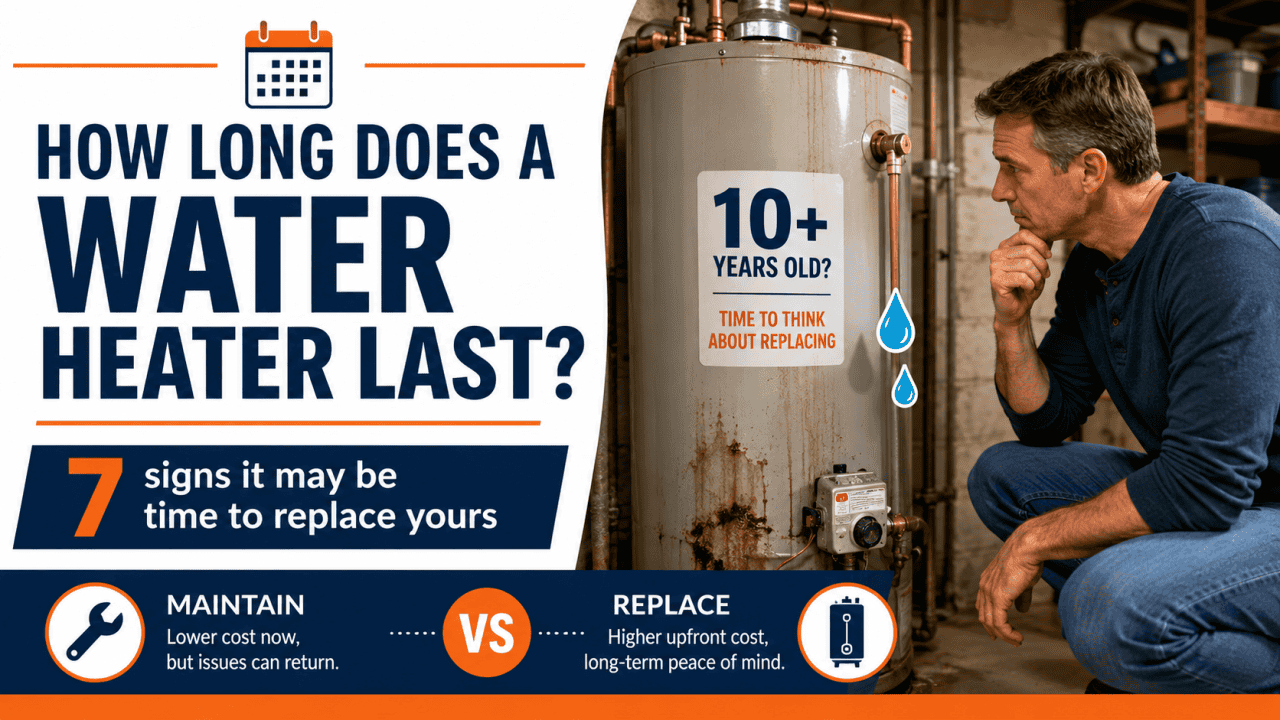
How Long Does a Water Heater Last? 7 Signs It May Be Time to Replace Yours
How long does a water heater last? For many homeowners, that question does not come up until the water suddenly turns cold, the tank begins leaking, or a repair technician delivers an uncomfortable estimate.
That is not the ideal time to start thinking about replacement.
A water heater is one of those household systems that can operate quietly for years before showing obvious signs of trouble. But as it ages, the probability of leaks, corrosion, heating problems, and expensive repairs generally increases.
Knowing the age and condition of your water heater can help you decide whether to maintain it, repair it, or replace it before a failure becomes an emergency.
Here is what homeowners should know.
How Long Does a Water Heater Last on Average?
There is no single expiration date that applies to every water heater.
The useful life of a unit depends on factors such as:
- water-heater type;
- installation quality;
- water quality;
- maintenance;
- household demand;
- operating temperature;
- corrosion;
- manufacturing quality.
Traditional storage-tank water heaters commonly remain in service for many years, but two units installed on the same day can age very differently.
A lightly used system in a home with favorable water conditions may continue operating reliably well beyond the point when another unit has already failed.
That is why age should be treated as a risk indicator, not an automatic replacement order.
The better question is:
Is this water heater old and beginning to show signs of deterioration?
That combination matters much more.
First, Find Out How Old Your Water Heater Is
Before making any repair-or-replace decision, determine the approximate installation or manufacturing date.
Check the manufacturer’s label on the unit.
It usually includes:
- brand;
- model number;
- serial number;
- capacity;
- fuel or energy type;
- manufacturing information.
The serial number often encodes the manufacturing date, although the format varies by manufacturer.
If you cannot determine it from the label, search the manufacturer’s documentation using the model and serial number.
Also check:
- home purchase records;
- previous owner’s records;
- contractor invoices;
- warranty documents.
Knowing whether the unit is 3 years old or 13 years old materially changes how you should evaluate a $500 repair.
Why Water Heater Age Matters
Imagine two homeowners receive the same repair quote.
Homeowner A
- Water heater: 4 years old
- First major problem
- Tank appears sound
- Repair estimate: $350
Homeowner B
- Water heater: 13 years old
- Previous repair already completed
- Visible corrosion near connections
- Repair estimate: $350
The repair costs are identical.
The economics are not.
Homeowner A may be buying many more years of useful service.
Homeowner B may be spending $350 on a system that could soon develop an unrelated failure.
This is the fundamental principle behind appliance replacement:
Repair cost must be evaluated against remaining useful life—not simply against today’s replacement price.
1. Your Water Heater Is Getting Old
Age alone does not mean a water heater is failing.
But it changes the risk calculation.
As equipment ages:
- components wear;
- corrosion may progress;
- sediment can accumulate;
- seals and valves deteriorate;
- the likelihood of additional repairs may increase.
If your water heater is still relatively young and otherwise healthy, a repair can make excellent financial sense.
If it is already well into the later stage of its life and needs an expensive repair, replacement deserves much more consideration.
The older the unit becomes, the less attractive a major repair generally becomes.
2. You See Water Around the Tank
Water around a water heater should never be ignored.
However, water near the unit does not automatically mean the tank itself has failed.
Possible sources can include:
- plumbing connections;
- valves;
- drain components;
- condensation;
- nearby pipes;
- the tank itself.
Some of these problems may be repairable.
A leaking tank is a different situation.
If the actual storage tank has deteriorated and is leaking, repairing the tank itself is generally not comparable to replacing an external valve or fitting.
Why early detection matters
A water heater problem can become more than an appliance problem.
Escaping water can damage:
- flooring;
- drywall;
- cabinetry;
- framing;
- stored belongings.
If significant leakage is occurring, do not continue operating the system as if nothing is wrong.
Have the source properly identified.
For gas or electrical systems, do not attempt repairs involving components you are not qualified to service.
3. Your Hot Water Runs Out Much Faster Than Before
Maybe the water heater still works.
It just does not work as well as it used to.
You might notice:
- showers turning cold sooner;
- difficulty supplying multiple fixtures;
- water taking longer to recover;
- inconsistent hot-water availability.
Several issues can contribute to reduced capacity or performance.
The key question is whether the problem represents:
a repairable component failure
or
broader deterioration in an aging system.
If a relatively new water heater suddenly loses performance, diagnosis makes sense.
If an old water heater has become progressively worse while also developing other symptoms, replacement may be more economical.
4. The Water Temperature Becomes Unpredictable
A healthy water heater should provide reasonably consistent output.
Warning signs can include:
- water never becoming sufficiently hot;
- temperature fluctuating significantly;
- hot water disappearing unexpectedly;
- repeated resetting or adjustment.
These symptoms do not necessarily mean the entire unit needs replacement.
Depending on the system, causes can involve controls, heating components, thermostatic issues, burners, sensors, or other serviceable parts.
Age again becomes the decision filter.
A component worth replacing in a younger system may not be worth replacing in an older system that already has several developing issues.
5. You Notice Rust-Colored or Discolored Hot Water
Discolored water deserves investigation.
The source is not always the water heater.
Problems elsewhere in the plumbing or water supply can also affect water appearance.
But if discoloration seems associated specifically with the hot-water system, the water heater should be considered as one potential source.
Corrosion is particularly important because storage tanks are constantly exposed to water.
Do not assume discoloration means immediate catastrophic failure, but do not ignore a persistent change either.
A qualified professional can help determine whether the problem is:
- water chemistry;
- plumbing;
- sacrificial components;
- sediment;
- internal corrosion;
- another cause.
If the tank itself is substantially deteriorating, replacement can become the sensible option.
6. The Water Heater Is Making New or Unusual Noises
Water heaters are not always silent.
But changes matter.
You may begin hearing:
- popping;
- banging;
- rumbling;
- crackling;
- other unfamiliar sounds.
Some noises can relate to sediment or operating conditions rather than imminent failure.
Still, a unit that has suddenly become much noisier deserves attention—particularly when it is older or accompanied by poor performance.
The mistake is focusing on a single symptom in isolation.
An old water heater that:
- makes unusual noises;
- produces inconsistent hot water;
- shows corrosion;
- has already needed repairs
is giving you a much stronger replacement signal than noise alone.
7. Repair Costs Keep Adding Up
One repair is normal.
A sequence of repairs is different.
Suppose you spend:
- $250 this year;
- $300 eight months later;
- another $400 soon afterward.
The decision should no longer be:
Is this latest $400 repair cheaper than a new water heater?
You should ask:
How much have I already spent keeping this system alive, and what is the probability that another component fails next?
Repeated repair spending can become a form of sunk-cost thinking.
Homeowners sometimes continue repairing an aging unit because they already spent money on it.
But previous repair spending should not force you into the next repair.
The relevant question is whether the next dollar is best spent repairing the existing unit or replacing it.
Repair or Replace? Use This Framework
Instead of relying on one rule, evaluate four factors together.
1. Age
How far into its likely service life is the system?
2. Repair cost
How much will today’s problem cost to fix?
3. Overall condition
Are there corrosion, leakage, noise, or performance problems beyond the diagnosed failure?
4. Replacement cost
What would a properly installed comparable replacement actually cost?
These variables give you a much better decision than age alone.
Compare Repair Cost With Installed Replacement Cost
Do not compare a repair quote only with the advertised price of a replacement water heater.
The real replacement cost may include:
- equipment;
- installation labor;
- removal of the old unit;
- permits where required;
- fittings;
- venting modifications;
- electrical work;
- plumbing changes;
- code-related upgrades.
Suppose:
Repair estimate: $650
New water heater: $1,100
At first glance, repair looks much cheaper.
But suppose the true installed replacement cost is:
$1,750
Now calculate:
$650 ÷ $1,750 = approximately 37%
That gives you a much more useful comparison.
A 37% repair on a relatively young, healthy unit may make sense.
The same repair percentage on an old unit with corrosion and previous failures may not.
The Water Heater Decision Matrix
| Situation | Likely Direction |
|---|---|
| Younger unit + inexpensive isolated repair | Repair |
| Younger unit + major failure | Compare repair and replacement |
| Older unit + very minor repair | Repair may still make sense |
| Older unit + expensive repair | Replacement becomes attractive |
| Actual tank leakage | Strong replacement signal |
| Multiple recent repairs | Strong replacement signal |
| Significant corrosion | Investigate replacement |
| Performance problem with otherwise healthy unit | Diagnose first |
| Major repair plus several other warning signs | Replacement often makes more sense |
This is intentionally not a rigid formula.
A premium system and a basic system can have completely different replacement economics.
Tank vs. Tankless Changes the Calculation
When asking how long does a water heater last, the type of system matters.
A traditional tank system and a tankless system have different:
- designs;
- maintenance requirements;
- repair profiles;
- installation costs;
- replacement economics.
Tankless equipment can potentially remain in service for a long time when properly maintained, but that does not automatically mean converting from a tank system is financially superior.
A conversion may require changes to:
- gas supply;
- venting;
- electrical service;
- plumbing;
- installation configuration.
Therefore, compare total installed cost, not simply product prices.
Should You Replace a Working Water Heater Before It Fails?
Sometimes.
But not automatically.
Proactive replacement can make sense when:
- the unit is very old;
- failure would cause significant property damage;
- the installation location creates high water-damage risk;
- warning signs have begun appearing;
- you are already renovating nearby systems;
- you want to avoid an emergency replacement.
Emergency replacement has disadvantages.
You may have:
- less time to compare contractors;
- fewer product choices;
- greater scheduling pressure;
- less negotiating leverage;
- several days without hot water.
Planned replacement gives you time.
But replacing reliable equipment too early also destroys remaining economic value.
This is a risk-management decision.
Do New Water Heaters Save Enough Energy to Justify Replacement?
Possibly—but energy savings should usually be evaluated carefully.
A newer system may operate more efficiently.
However, efficiency alone does not automatically justify throwing away a functioning water heater.
Calculate the economics.
Suppose a replacement would save an estimated amount per year, but the total installed cost is several thousand dollars.
The simple payback period may be much longer than expected.
Efficiency becomes more financially compelling when:
- the existing unit already needs a major repair;
- energy prices are high;
- household hot-water consumption is substantial;
- the replacement system provides a meaningful efficiency improvement.
Energy savings should usually support a replacement decision rather than manufacture one where none existed.
Maintenance Can Affect Water Heater Life
Homeowners often ask how long does a water heater last, but maintenance is part of the answer.
Maintenance requirements vary by model, manufacturer, water conditions, and system type.
Relevant considerations can include:
- sediment accumulation;
- corrosion protection;
- valves;
- connections;
- venting;
- burner or heating components;
- tankless-system descaling where applicable.
Follow the manufacturer’s maintenance requirements rather than relying on generic internet schedules.
If your system has not been serviced for many years, do not automatically start disassembling or flushing components without understanding the condition of the equipment and manufacturer instructions.
An older neglected unit can require a different approach from a newer maintained system.
Know Where the Water Shutoff Is
This is one of the simplest things every homeowner should know.
Before a water-heater emergency happens, identify:
- the water shutoff associated with the system;
- the main home water shutoff;
- how to safely shut down the equipment according to its type and manufacturer instructions.
Do not wait until water is spreading across the floor to learn where the valve is located.
For gas or electrical emergencies, follow proper safety procedures and contact qualified professionals where required.
Before Approving a Major Repair, Ask These Questions
If a technician recommends an expensive repair, ask:
What exactly failed?
You need a diagnosis, not simply a price.
Is the tank itself in good condition?
An expensive external-component repair is difficult to justify if the tank is already deteriorating.
Are there signs that another major component may soon need attention?
No technician can predict the future perfectly, but visible deterioration matters.
What warranty comes with the repair?
A repair with meaningful parts and labor coverage has different economics from one with little protection.
What would the installed replacement cost be?
Compare total costs, not appliance sticker prices.
Given the age and condition, would you repair this unit if it were your home?
A credible technician should be able to explain the reasoning behind the recommendation.
When Replacement Is Usually the Cleaner Decision
Replacement becomes increasingly rational when several conditions occur at once:
- advanced age;
- actual tank leakage;
- significant corrosion;
- expensive repair;
- repeated service calls;
- declining hot-water performance;
- replacement parts becoming difficult to obtain;
- other components visibly deteriorating.
One symptom may justify diagnosis.
Five symptoms together tell a different story.
When Repair Still Makes Sense
Do not replace equipment simply because a salesperson says it is old.
Repair can remain attractive when:
- the system is relatively young;
- the failure is isolated;
- the tank is sound;
- there is no meaningful corrosion;
- no leakage exists;
- the repair is inexpensive relative to replacement;
- no pattern of repeated failures exists.
Replacing a healthy $1,500–$3,000 installed system because of a modest repair can be financially wasteful.
The goal is not to own the newest water heater.
The goal is to minimize total ownership cost and failure risk.
The Bottom Line
So, how long does a water heater last?
There is no exact number that determines when every unit should be replaced.
Age is important, but condition matters more.
A good decision combines:
Age + repair cost + tank condition + reliability history + installed replacement cost.
If the water heater is relatively young, structurally sound, and facing an isolated affordable repair, keeping it in service may be the smarter financial decision.
If it is old, leaking, corroded, unreliable, and facing another major repair, replacement may cost more today but reduce the risk of paying twice tomorrow.
Do not wait for complete failure to understand which situation you are in.
Know the age of your water heater now.
That one piece of information can make the next repair decision significantly easier.