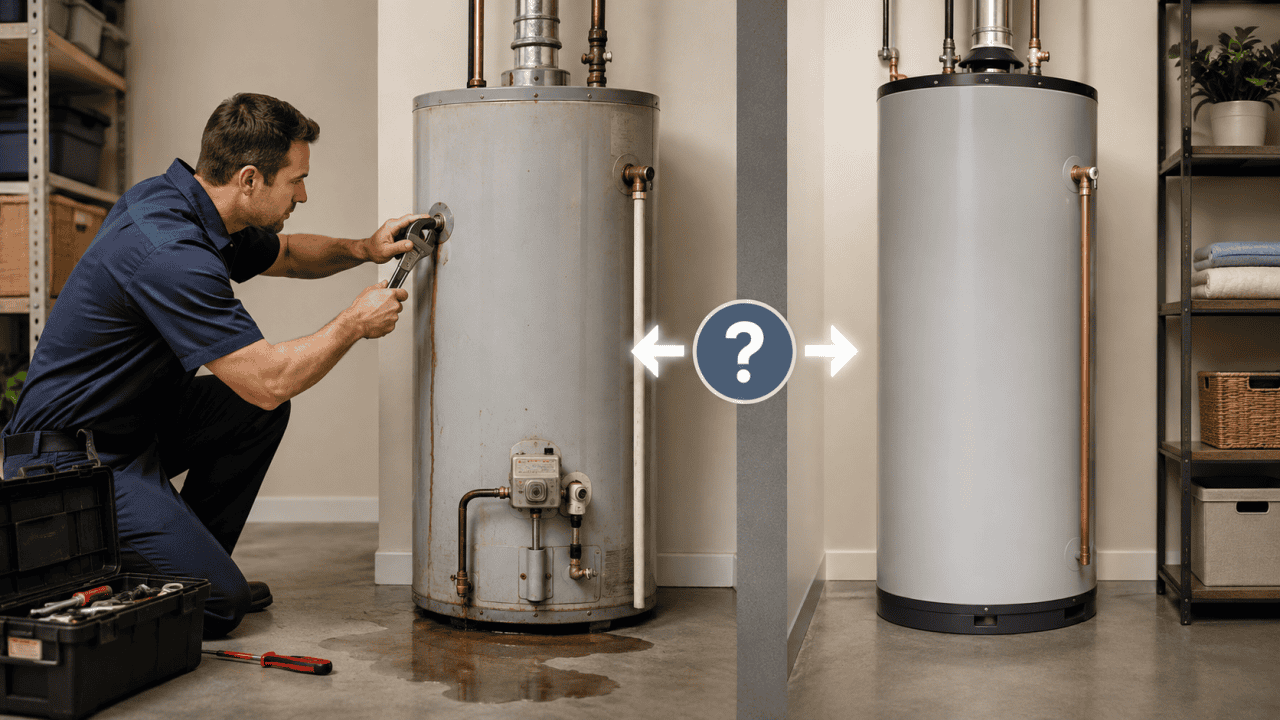
Water heater leaking? Before you assume the entire unit has failed, find out where the water is actually coming from.
A small amount of water around a fitting, drain valve or plumbing connection can point to a repairable problem. Water appearing through the body or bottom of an aging tank is a very different situation. In that case, continuing to spend money on repairs can simply delay a replacement that is already approaching.
The useful question is therefore not simply, “Can this water heater be repaired?” Almost anything can be worked on. The better question is whether repairing this particular unit is financially sensible once you consider the source of the leak, the heater’s age, its condition and the likelihood of another failure.
Here is how to make that decision.
First, Treat an Active Leak as a Damage-Control Problem
If water is actively escaping from the heater, the first priority is limiting additional water damage rather than diagnosing every component yourself.
If you can safely do so, stop the water supply to the heater and follow the manufacturer’s instructions for shutting down the appliance. Electric and gas water heaters have different shutdown procedures, and water around electrical equipment creates an additional hazard. Do not handle wet electrical equipment or enter standing water to reach electrical controls.
Once the immediate flow is controlled, look at where the moisture first appears. Do not rely only on the puddle on the floor. Water can travel down pipes, insulation and the outside of the tank before collecting underneath the heater.
The U.S. Environmental Protection Agency recommends routinely checking water heaters for leaks, aging gaskets, loose connections and corrosion. It also recommends periodic maintenance because sediment accumulation and neglected components can reduce efficiency and contribute to problems over time.
The origin of the water is the first major dividing line between a repair and a replacement.
A Leak From a Pipe or Connection Is Often a Repair Problem
Start at the top of the water heater.
Inspect the cold-water inlet, hot-water outlet and visible plumbing connections. A loose threaded fitting, deteriorated seal or leaking connection can allow water to run down the outside of the tank, creating the impression that the tank itself has failed.
This distinction matters because replacing a fitting or correcting a plumbing connection is fundamentally different from replacing the water heater.
If the tank body is dry and the moisture clearly begins around external plumbing, the age of the water heater should still influence the decision, but replacement is not automatically justified.
For a relatively young heater in otherwise good condition, repairing the connection is usually the logical first move. For an older unit with significant corrosion elsewhere, the leak may simply be the first visible indication that additional failures are coming.
The repair should solve a defined defect, not merely buy a few uncertain months from a deteriorating system.
A Drain Valve Leak May Be Fixable
The drain valve near the bottom of a conventional tank is another common place to inspect.
A small drip from the valve does not necessarily mean the storage tank has ruptured. The valve itself may be worn, damaged or not fully closed. A plumber may be able to repair or replace it without replacing the entire heater.
But there is an important difference between water coming from the drain valve and water emerging around the tank shell near the bottom.
If you cannot identify a specific external component as the source, do not assume the drain valve is responsible simply because the puddle happens to be beneath it.
This is particularly important with older tanks because gravity makes almost every leak eventually appear at floor level.
Water From the Tank Itself Changes the Decision
A leaking storage tank is the scenario in which replacement becomes much more likely.
Traditional tank-style water heaters store dozens of gallons of heated water inside a steel vessel. Once corrosion compromises that vessel, replacing external valves or fittings does not restore the structural integrity of the tank.
The age of the heater becomes especially relevant here. U.S. Department of Energy material has historically placed the expected life of traditional storage water heaters at roughly 10 to 15 years, while noting that tankless equipment can have a substantially longer service life. Actual life varies with water chemistry, maintenance, installation quality and operating conditions, so age should be treated as a decision factor rather than an expiration date.
A seven-year-old water heater with a leaking replaceable fitting is therefore a very different economic proposition from a 13-year-old unit showing corrosion and moisture from the tank itself.
The second heater may still produce hot water today. That does not make it a good repair candidate.
Do Not Confuse Condensation With a Failed Tank
Not every wet water heater is actually leaking.
Condensation can form in some operating conditions, and nearby plumbing, HVAC equipment, condensate drains or other appliances can also put water on the floor around a heater.
Before approving an expensive replacement, establish the source.
Dry the accessible exterior surfaces and surrounding floor, then observe where moisture reappears. If the source remains unclear, having a qualified plumber diagnose it is generally cheaper than replacing a functioning appliance based on the location of a puddle alone.
This sounds obvious, but it is a useful consumer rule: diagnose the component that failed before pricing the solution.
Age Should Change How Much You Are Willing to Repair
Homeowners often evaluate a repair quote in isolation.
A $400 repair sounds cheaper than a $2,000 replacement, so the repair appears to win automatically. That comparison is incomplete.
You are not comparing $400 with $2,000. You are comparing the expected remaining value of the repaired old heater with the expected value of a replacement.
An older unit may require another service call later, may be less efficient than current alternatives and may fail at a time when you have little opportunity to compare equipment or contractors.
A useful JanMuse decision rule is to become progressively less willing to fund substantial repairs as a conventional tank heater approaches the later portion of its expected service life. This is not a manufacturer warranty rule or an industry standard; it is a household capital-allocation rule.
If the repair is inexpensive, addresses an isolated external component and the tank is in good condition, repairing can still make sense.
If the repair is expensive, the unit is already old, corrosion is visible or multiple components have begun failing, replacement deserves serious consideration even if a technician could technically keep the old heater operating.
Check the Warranty Before Paying for Either Option
Before authorizing a major repair, find the model and serial number and determine whether any manufacturer warranty remains.
Do not assume that “under warranty” means the entire repair will be free. Coverage may apply to certain components but not labor, shipping, diagnostic charges or damage caused by conditions excluded from the warranty.
The Federal Trade Commission advises consumers to review what a written warranty actually covers, how claims must be made and whether repair, replacement or another remedy is provided. It also recommends retaining the warranty and proof of purchase.
This can materially change the economics.
A failed component that looks like a $600 repair may become a much smaller out-of-pocket expense if the part is covered. Conversely, a homeowner who assumes labor is included when it is not may underestimate the real cost of keeping the old unit.
Call the manufacturer or check the warranty documentation before approving non-emergency work.
If You Replace an Electric Water Heater, Compare More Than the Purchase Price
Replacement creates another decision: replace like-for-like, or use the failure as an opportunity to change technology.
For homes currently using a conventional electric resistance water heater, a heat pump water heater deserves consideration.
ENERGY STAR says certified heat pump water heaters can save a household of four approximately $550 per year in electricity compared with a standard electric water heater under the assumptions used in its savings model. The organization also notes that these systems generally cost more upfront, so the relevant comparison is lifecycle cost rather than sticker price alone.
That does not make a heat pump water heater the automatic winner.
Installation conditions matter. ENERGY STAR guidance notes that these units need an appropriate installation environment, including sufficient surrounding air volume and suitable temperatures. They can also cool the space in which they operate, and installation may be more involved than replacing a conventional electric tank with another conventional tank.
The decision therefore needs to include equipment cost, installation changes, household hot-water demand, local electricity prices, available incentives and how long you expect to remain in the home.
A higher purchase price can be rational if the operating savings justify it. It is not rational merely because the replacement technology is newer.
Emergency Replacement Is Usually the Most Expensive Time to Shop
One of the hidden costs of keeping a deteriorating water heater too long is the loss of purchasing flexibility.
When the tank fails completely and a household suddenly has no hot water, homeowners tend to optimize for speed. They are more likely to accept whichever unit is immediately available and whichever contractor can install it first.
ENERGY STAR specifically encourages homeowners to plan for replacement before an aging water heater fails so there is time to evaluate technology, sizing, contractors and available rebates rather than making the entire decision during an emergency.
This is why an old but still functioning water heater should not necessarily be viewed as having zero current cost.
It carries an optionality risk: the longer replacement is postponed, the greater the chance that the eventual purchase will be made under time pressure.
For a unit already showing corrosion, repeated repairs or minor leakage, planned replacement may therefore have value even before complete failure.
Get the Scope of Work in Writing
A water heater failure can create urgency, and urgency weakens consumers’ negotiating position.
If replacement is necessary and the situation allows enough time, obtain more than one written estimate and make sure the quotes are comparable. One contractor may be quoting only the appliance and basic installation while another includes permit work, disposal, piping modifications, expansion equipment or code-related upgrades.
The lowest number on the first page is not necessarily the lowest final installed cost.
The Federal Trade Commission recommends checking licensing and insurance where applicable, obtaining multiple estimates and getting the scope, materials and pricing in writing. It also warns against contractors who demand an immediate decision or full payment upfront.
For a water heater replacement, ask exactly what is included before comparing bids.
A vague quote is difficult to compare and easy to expand later.
So, Should You Repair or Replace a Leaking Water Heater?
The decision becomes much simpler once the source of the leak is known.
If the water is coming from an accessible plumbing connection, gasket, valve or other replaceable external component, the heater is relatively young and the tank itself is sound, repair is usually worth investigating first.
If water is coming from the tank body, visible corrosion is substantial, the heater is already near the later end of its expected life or you are beginning to pay for repeated failures, replacement is usually the stronger economic decision.
Between those two extremes is the area where homeowners should stop asking whether a repair is technically possible and start asking what they are purchasing with the repair.
Are you buying several more years of dependable service?
Or are you spending hundreds of dollars to postpone a predictable replacement?
That is the distinction that matters.
The Bottom Line
A water heater leaking is not automatically a water heater that needs to be replaced. The leak source determines the first step; the unit’s age and condition determine how much money it is rational to put into the repair.
External connection and valve problems may justify a straightforward fix. Leakage from a deteriorating storage tank usually shifts the calculation toward replacement. For an aging electric heater, replacement is also an opportunity to compare the long-term operating economics of conventional and heat pump models rather than automatically purchasing the closest equivalent.
Control the leak first. Identify the failed component second. Then compare the cost of repairing the old asset with the value of the remaining life you reasonably expect to receive from it.
That sequence prevents a plumbing problem from becoming a bad capital decision.
Sources
This guide draws on homeowner maintenance guidance from the U.S. Environmental Protection Agency, water-heating and equipment-life information from U.S. Department of Energy resources, heat pump water heater guidance and savings estimates from ENERGY STAR, and consumer warranty and contractor guidance from the Federal Trade Commission.