A contractor gives you a quote for a home repair.
The number looks high.
But is it actually overpriced—or is the job simply more complicated than you expected?
That distinction matters.
Rejecting a reasonable quote can waste time and delay an important repair. Accepting an inflated quote can cost you thousands of dollars.
The problem is that most homeowners do not buy roofing, plumbing, electrical, HVAC, or remodeling services often enough to know what a fair price looks like.
So instead of asking only:
“Is this quote expensive?”
ask a better question:
“Does this quote make economic and technical sense for the work being proposed?”
Here is how to evaluate it.
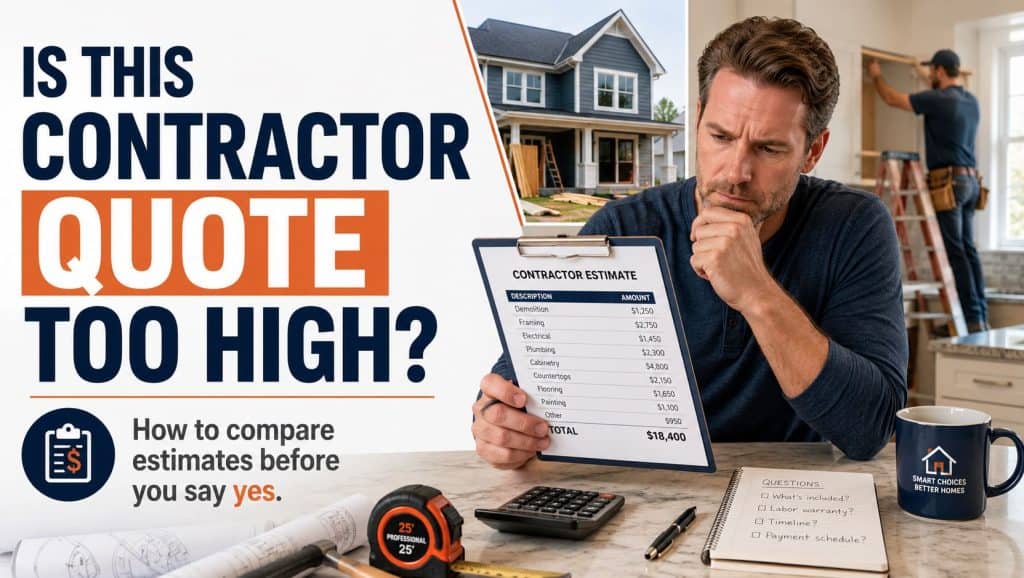
1. Do Not Judge a Quote by the Total Price Alone
A contractor quote is not just a number.
It should represent several cost components:
- labor;
- materials;
- equipment;
- permits;
- disposal;
- subcontractors;
- travel;
- insurance;
- overhead;
- warranty exposure;
- profit.
Two contractors can quote very different prices and both may be legitimate.
For example, one quote may include:
- permit fees;
- upgraded materials;
- debris removal;
- a longer workmanship warranty.
Another may appear cheaper because those items are excluded.
That is why comparing only the final dollar amount can be misleading.
The first question should be:
What exactly am I buying?
2. Ask for a Written Scope of Work
A vague quote is difficult to evaluate.
“Repair bathroom: $4,500” tells you almost nothing.
A useful quote should explain the work in enough detail that you can compare it with another contractor’s proposal.
Look for items such as:
- what will be removed;
- what will be repaired;
- what materials will be used;
- approximate quantities;
- what will be replaced;
- what will be reused;
- disposal responsibility;
- permit responsibility;
- cleanup;
- warranty;
- exclusions.
You do not necessarily need a line-by-line breakdown of every screw and hour of labor.
But you should understand the scope.
If two contractors are bidding on different scopes, their prices are not directly comparable.
3. Compare Like With Like
Suppose Contractor A quotes $8,000.
Contractor B quotes $6,200.
At first glance, B looks much cheaper.
But Contractor A includes:
- upgraded materials;
- demolition;
- disposal;
- permit fees;
- repair of damaged underlying material;
- cleanup;
- five-year workmanship warranty.
Contractor B excludes several of those items.
The $1,800 difference may disappear once the work is normalized.
This is one of the most common mistakes homeowners make when comparing quotes.
Create a simple comparison table:
| Item | Contractor A | Contractor B | Contractor C |
|---|---|---|---|
| Demolition | Included | Included | Included |
| Materials | Premium | Standard | Standard |
| Disposal | Included | Extra | Included |
| Permit | Included | Owner pays | Included |
| Cleanup | Included | Included | Included |
| Warranty | 5 years | 1 year | 3 years |
| Total | $X | $Y | $Z |
Now you are comparing actual value rather than headline price.
4. Get More Than One Quote—But Not Twenty
For a meaningful home repair, multiple quotes are useful.
The objective is not to conduct an auction.
It is to establish a market range and understand how different contractors diagnose the job.
Three serious proposals are often far more useful than ten superficial ones.
If the quotes come back:
- $7,800;
- $8,300;
- $8,500;
and one contractor says:
- $4,100,
the cheap quote deserves as much scrutiny as an expensive outlier.
The reverse is also true.
If three qualified contractors are clustered around $4,500 and one asks $9,000 for essentially the same work, you have a reason to investigate the difference.
Price outliers require explanation
An outlier is not automatically dishonest.
There may be a legitimate reason:
- different materials;
- higher insurance costs;
- specialized expertise;
- additional structural work;
- faster completion;
- stronger warranty;
- unusually difficult site conditions.
But the contractor should be able to explain why the proposal is different.
5. Understand That Labor Is Not Just Hourly Wages
Homeowners sometimes calculate contractor pricing like this:
“Two workers for eight hours. They probably earn $30 an hour. Why does this cost $2,000?”
That calculation ignores the economics of operating a contracting business.
A contractor may need to cover:
- payroll taxes;
- workers’ compensation;
- liability insurance;
- vehicles;
- fuel;
- tools;
- equipment;
- office staff;
- licensing;
- advertising;
- estimating time;
- callbacks;
- warranty work;
- unbillable travel time.
The worker’s hourly wage is not the contractor’s hourly cost.
And the contractor’s cost is not the same as the price charged to the customer.
A healthy contractor must make a profit or the business eventually disappears.
The question is not whether there is markup.
There should be.
The question is whether the markup and total price are reasonable relative to the market and scope.
6. Check Whether Materials Are Driving the Price
Material selection can create large differences between proposals.
Ask:
- What brand is being used?
- What grade or specification?
- Is the material contractor-grade or premium?
- Is there a manufacturer warranty?
- Are all required components included?
- Is the quote based on current pricing?
For example, two window replacements may look identical in a short proposal but involve very different products.
The same can happen with:
- roofing;
- flooring;
- plumbing fixtures;
- electrical components;
- insulation;
- HVAC equipment;
- cabinetry.
Do not assume “same job” means “same materials.”
7. Ask About What Happens When the Contractor Finds Hidden Damage
Many home repairs contain uncertainty.
A contractor opens a wall and discovers:
- rot;
- mold;
- damaged framing;
- old wiring;
- corroded plumbing;
- previous improper repairs.
That can legitimately increase the project cost.
But you should know how changes will be handled before work begins.
Ask:
What happens if additional damage is discovered?
A professional process typically involves a written change order describing:
- the newly discovered condition;
- additional work;
- additional cost;
- schedule impact.
Be cautious when a contractor expects unlimited authority to “do whatever is necessary” and bill you later.
Uncertainty is normal.
Unlimited financial exposure is not.
8. Look at the Payment Schedule
The payment structure can tell you a lot.
Large projects often require deposits or progress payments because contractors need to purchase materials and pay crews.
But you should understand:
- deposit amount;
- payment milestones;
- what triggers each payment;
- final payment conditions.
Avoid paying the entire project cost before meaningful work has been completed.
A payment schedule should generally align the contractor’s cash needs with actual project progress.
Example
Instead of:
100% before work begins
a larger project may use something closer to:
- deposit;
- payment after materials arrive;
- payment after major milestone;
- final payment after completion.
Exact structures vary by contractor, project, and local law.
The important point is maintaining reasonable balance between both parties.
9. Do Not Ignore Licensing, Insurance, and Permits to Save Money
A cheaper contractor may be cheaper for a reason.
Before choosing a contractor for work that requires professional credentials, verify relevant requirements in your state or local jurisdiction.
Depending on the work, important considerations can include:
- contractor licensing;
- trade licensing;
- liability insurance;
- workers’ compensation;
- permits;
- inspections.
Skipping permits or using improperly qualified labor can create problems later.
Potential consequences may include:
- failed inspections;
- insurance issues;
- safety problems;
- resale complications;
- expensive corrective work.
The cheapest legal and properly executed job may cost more than an informal shortcut.
That does not make it overpriced.
10. Be Careful With “Today Only” Pricing
Pressure is a red flag.
Statements such as:
“This price is only good if you sign right now.”
should make you slow down.
There can be legitimate reasons for limited pricing:
- volatile material costs;
- promotional periods;
- limited scheduling availability.
But a contractor should not need to prevent you from reading the contract, comparing quotes, or asking questions.
For substantial projects, you should understand:
- price;
- scope;
- payment terms;
- exclusions;
- warranty;
- cancellation provisions
before committing.
A good deal should still make sense after you have had time to read it.
11. Watch for Extremely Low Bids
Homeowners naturally fear overpaying.
But underpaying can be equally expensive.
A dramatically cheap contractor may be:
- missing part of the scope;
- using lower-grade materials;
- underestimating labor;
- uninsured;
- planning to add charges later;
- desperate for cash;
- inexperienced with the project.
Not every low bid is dangerous.
Sometimes a smaller contractor genuinely has lower overhead.
But an unusually low price should be explained just as carefully as an unusually high one.
Ask the low bidder:
“Your price is significantly lower than the others. What do you think they may be including that you are not?”
The answer can be revealing.
12. Evaluate the Warranty
A quote does not end when the crew leaves.
Ask what happens if:
- the repair fails;
- installation is defective;
- something leaks;
- a component comes loose;
- the finished work develops a problem.
Separate two types of warranty:
Manufacturer warranty
Covers the product or equipment, subject to its terms.
Workmanship warranty
Covers how the contractor installed or performed the work.
A strong product warranty is not useful if an installation problem is excluded.
Understand both.
13. Check Reviews for Patterns, Not Just Stars
A 4.9-star rating can look impressive.
But individual review patterns are more informative.
Look for recurring complaints about:
- surprise charges;
- missed appointments;
- poor communication;
- unfinished work;
- warranty refusal;
- damage;
- cleanup;
- aggressive sales practices.
Also read how the contractor responds to negative feedback.
Problems happen in every service business.
How a company resolves them tells you more than a perfect rating.
14. Ask How Long the Quote Is Valid
Contractor quotes often expire.
That is not necessarily a sales tactic.
Materials and subcontractor pricing can change.
Ask:
- how long the quote remains valid;
- whether price escalation is possible;
- what circumstances allow the price to change.
Get those terms in writing.
This becomes especially important for projects scheduled months in advance.
15. Check the Contract Before the Price
A surprisingly useful rule is:
The quality of the contract often tells you as much as the price.
A professional agreement should clearly identify:
- contractor;
- homeowner;
- project address;
- scope;
- price;
- payment schedule;
- approximate timeline;
- change-order process;
- warranty;
- exclusions.
Be careful with agreements containing large blank spaces, vague descriptions, or terms you do not understand.
Do not rely on verbal promises that contradict the written contract.
If something matters, ask to have it added.
The Three-Quote Test
A simple way to evaluate pricing is to obtain three comparable proposals.
Suppose you receive:
| Contractor | Quote |
| A | $7,600 |
| B | $8,100 |
| C | $12,900 |
Do not immediately conclude C is dishonest.
Ask why.
If Contractor C includes major structural work the other two missed, C may actually have diagnosed the project more accurately.
If all three scopes are essentially identical, the premium becomes harder to justify.
Now imagine:
| Contractor | Quote |
| A | $7,600 |
| B | $8,100 |
| C | $3,900 |
Contractor C should also trigger questions.
The correct decision is rarely:
Pick the lowest number.
It is:
Understand why the numbers differ.
A Contractor Quote Scorecard
Before signing, score the proposal across these areas:
Scope clarity
Can you clearly explain what the contractor will do?
Material clarity
Do you know what products are being installed?
Price position
Is the quote reasonably aligned with comparable bids?
Credentials
Have relevant licenses and insurance been verified?
Payment structure
Does the payment schedule make sense?
Change orders
Is there a documented process for additional work?
Warranty
Do you understand what is covered?
Reputation
Are there recurring problems in customer reviews?
Communication
Does the contractor answer questions clearly?
Contract quality
Are the important promises in writing?
A contractor does not need to be the cheapest to score highest.
Red Flags That Matter More Than a High Price
Price alone is not the biggest warning sign.
These are more concerning:
- refusing to provide a written scope;
- refusing to discuss licenses or insurance;
- demanding full payment immediately;
- insisting on cash only without documentation;
- refusing to provide a contract;
- aggressive pressure to sign;
- changing the price repeatedly without explanation;
- avoiding questions about permits;
- asking you to obtain permits improperly on their behalf;
- large unexplained differences between verbal and written promises.
An expensive contractor can still be excellent.
A cheap contractor can still be excellent.
Lack of transparency is the bigger problem.
What If Every Quote Seems Expensive?
Sometimes the market price is simply higher than the homeowner expected.
This is common because people may base expectations on:
- prices from years ago;
- online estimates covering different regions;
- material-only pricing;
- DIY project costs;
- a friend’s unrelated project.
If several independent, qualified contractors give you similar quotes, that cluster becomes useful market evidence.
You then have three choices:
Proceed
if the repair is necessary and economics make sense.
Reduce the scope
if some elements are optional.
Delay
if the project is non-urgent and waiting does not create additional damage or safety risks.
Do not force a project into an unrealistic budget by choosing a contractor you would otherwise consider unacceptable.
The Bottom Line
A contractor quote is too high when the price cannot be justified by the scope, materials, difficulty, market, credentials, warranty, and risk being assumed.
You cannot determine that from the total alone.
For substantial home repairs:
Get multiple comparable quotes.
Normalize the scope.
Ask why prices differ.
Verify credentials.
Understand change orders.
Read the contract.
Then choose the contractor offering the best combination of:
price + competence + scope + accountability.
The lowest bid can become the most expensive project if the work has to be done twice.
And the highest bid is not necessarily better simply because it costs more.
Your objective is not to find the cheapest contractor.
It is to find the lowest total-risk way to get the job done correctly.