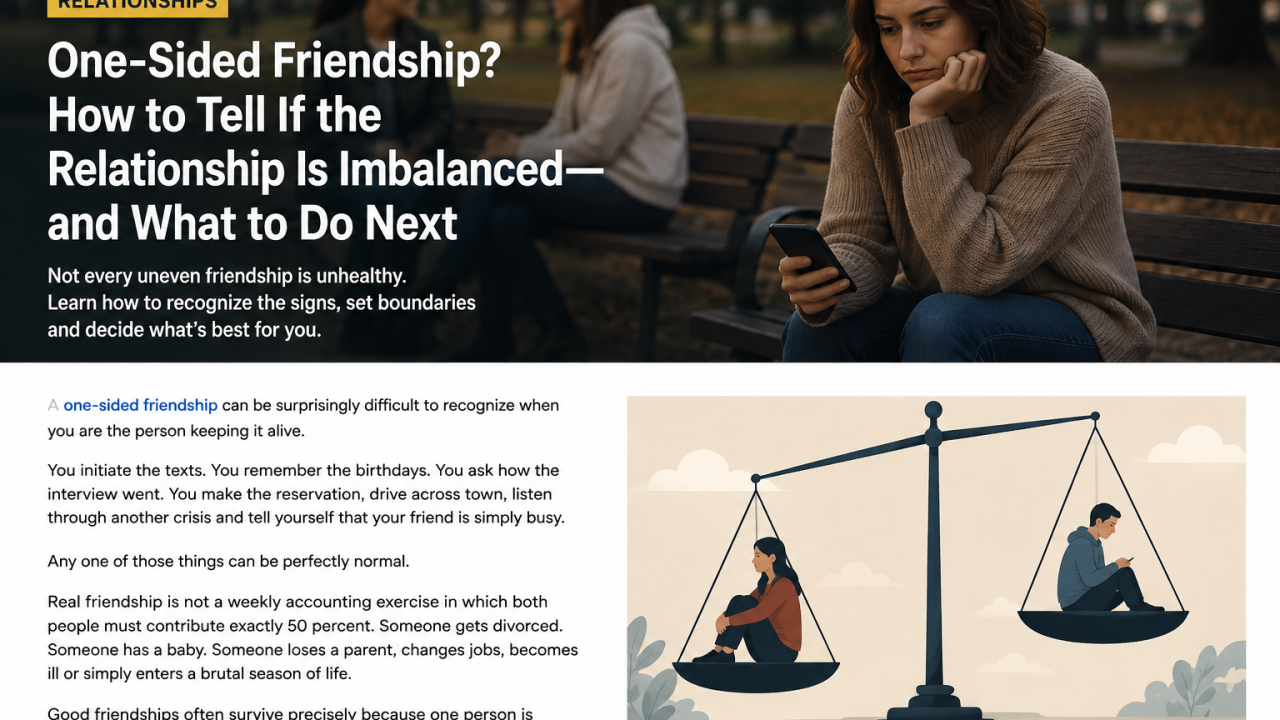
A one-sided friendship can be surprisingly difficult to recognize when you are the person keeping it alive.
You initiate the texts. You remember the birthdays. You ask how the interview went. You make the reservation, drive across town, listen through another crisis and tell yourself that your friend is simply busy.
Any one of those things can be perfectly normal.
Real friendship is not a weekly accounting exercise in which both people must contribute exactly 50 percent. Someone gets divorced. Someone has a baby. Someone loses a parent, changes jobs, becomes ill or simply enters a brutal season of life. Good friendships often survive precisely because one person is willing to carry more weight for a while.
The important words are for a while.
A friendship becomes meaningfully one-sided when temporary imbalance turns into the operating model of the relationship: one person repeatedly initiates, accommodates, supports and repairs while the other mostly receives.
That is different from having a busy friend.
It is also different from having a low-maintenance friend.
And before you cut someone out of your life because social media told you to “protect your energy,” it is worth figuring out which situation you are actually in.
Friendship Matters Enough to Diagnose Carefully
Friendship is not a trivial part of adult life.
Pew Research Center reported in 2025 that 81% of U.S. adults say they have at least one close friend outside their family, while 18% say they have none. Among adults who do have close friends, nearly three-quarters say they connect with one at least a few times a week through texting, social media, calls, video chats or in-person contact.
The larger health literature also treats social connection as more than a lifestyle preference. The U.S. Surgeon General’s advisory on social connection describes the structure, function and quality of relationships as important contributors to health and well-being and notes substantial evidence linking social disconnection with poorer health outcomes.
That does not mean every disappointing friendship needs to be preserved.
It means the better goal is not to maximize the number of people in your life. It is to build a social network in which the important relationships are sufficiently mutual, trustworthy and sustainable.
That requires a more precise standard than asking, “Who texted first?”
First, Stop Measuring Friendship by Message Count
A person can text you every morning and still be a poor friend.
Another person can disappear for three weeks, call when it matters and be one of the most dependable people in your life.
Frequency and reciprocity are related, but they are not the same thing.
The real question is whether there is mutual investment over time.
Imagine two friendships.
In the first, you initiate seven of the last ten conversations. Your friend has young children, works long hours and is terrible at texting. But when your father is hospitalized, she calls that night, remembers the follow-up appointment and offers to bring dinner.
In the second, you initiate only five of ten conversations. The numbers look balanced. But every conversation eventually becomes about your friend’s problems. When you need support, the subject changes within five minutes.
Which friendship is more reciprocal?
Probably the first.
This is why a one-sided friendship should be evaluated across several dimensions rather than a single visible behavior.
JanMuse uses four:
Initiative. Responsiveness. Reliability. Repair.
Together, they reveal much more than texting frequency.
Sign 1: You Are Responsible for Keeping the Relationship in Motion
Initiative is the most obvious dimension.
If you stop texting, do you suspect the friendship would disappear?
You make the plans. You follow up when nobody chooses a date. You suggest another weekend when they cancel. You send the birthday message. You reopen the conversation after months of silence.
Again, none of this proves the friendship is one-sided.
Some people are social organizers. Others are passive planners. Two people can genuinely value one another while having very different levels of initiative.
The important question is what happens when your initiative is temporarily removed.
Does your friend eventually notice the distance and reach toward you?
Or does the relationship simply stop?
That distinction is revealing because friendship needs some source of energy from both sides. The contributions do not have to look identical, but if every form of momentum originates with one person, the relationship is structurally fragile.
You may not have a friendship that is being mutually maintained.
You may have a friendship that exists because you continuously maintain it.
Those are not the same thing.
Sign 2: They Want Access to Your Attention but Show Little Curiosity About Your Life
A more consequential sign is asymmetry in attention.
Your friend knows how to contact you when something happens at work. You know the names of their coworkers, the history of their relationship, the details of the problem with their mother and what their doctor said last Thursday.
Then consider what they know about you.
Do they ask follow-up questions?
Do they remember things you told them?
When you share something important, does the conversation remain with you long enough for you to feel heard?
Or does your disclosure serve mainly as a bridge back to their life?
There is a substantial difference between a talkative friend and a friend who consistently occupies the emotional center of the relationship.
Talkative people can still be deeply attentive.
The problem is not the number of words spoken. It is whether your internal life has meaningful space in the relationship.
A useful test is simple: after you tell this person something significant, what happens next?
Attention is one of the currencies of friendship.
If it consistently flows in one direction, pay attention.
Sign 3: Your Problems Become Inconvenient, While Theirs Become Emergencies
Support is rarely symmetrical in real time.
When someone loses a job, gets divorced or cares for a sick parent, healthy friendships can become heavily unbalanced for months.
The distinction is whether the imbalance is caused by circumstances or entitlement.
A friend going through chemotherapy may have very little capacity to support you. That tells you almost nothing about the long-term quality of the friendship.
A friend who routinely expects two-hour crisis calls but becomes unavailable whenever your life is difficult tells you much more.
Watch how the relationship behaves when you become the person with needs.
Do they create space?
Do they follow up?
Do they offer what they realistically can?
Or do you find yourself minimizing your problems because you already know they will seem bored, competitive, dismissive or irritated?
A friendship can survive unequal resources.
It struggles to survive when only one person’s needs are treated as legitimate.
Sign 4: You Accommodate Their Life; They Rarely Accommodate Yours
One-sidedness is often hidden inside logistics.
You always drive farther.
You meet near their home.
You change the restaurant because they prefer something else.
You adjust to their work schedule.
You accept last-minute plans because that is when they are available.
You move the date after they cancel.
Individually, these accommodations seem too small to matter.
Over several years, they reveal the architecture of the relationship.
Healthy relationships contain flexibility. Sometimes one person’s constraints genuinely are tighter.
But constraints and convenience are different.
A parent of three young children may realistically have much less scheduling flexibility than a single friend. A person with a disability may need particular locations. Someone caring for an elderly parent may have a narrow window of availability.
Fairness does not require pretending those differences do not exist.
The question is whether your friend demonstrates some willingness to absorb inconvenience when they can.
Mutuality is not equal sacrifice.
It is evidence that both people’s time matters.
Sign 5: You Have Become Their Support System, but Not Their Friend
Some relationships gradually become functional.
One person becomes the listener.
The career adviser.
The emergency ride.
The person who fixes the résumé.
The backup babysitter.
The one who talks them through every breakup.
Being useful to a friend is not the problem. Helping one another is one of the valuable functions of close relationships.
The problem begins when utility replaces mutual relationship.
Ask yourself what remains when your friend does not need anything.
Do they contact you simply because they enjoy you?
Do you laugh together?
Do they invite you into good moments as well as bad ones?
Does the relationship contain curiosity, affection, pleasure and shared experience—or mostly requests, crises and emotional processing?
If somebody primarily appears when they need a function performed, you may be occupying a role rather than participating in a friendship.
That distinction can be uncomfortable because being needed often feels a lot like being valued.
It is not always the same thing.
Sign 6: Saying No Creates More Trouble Than the Favor Was Worth
Boundaries reveal relationship structure quickly.
Suppose your friend asks for a favor and you cannot do it.
In a healthy friendship, disappointment is possible. Pressure may even happen occasionally.
But your no does not fundamentally threaten the relationship.
In a chronically one-sided friendship, refusal can produce something different: guilt, coldness, anger, punishment, accusations or a sudden withdrawal of affection.
This is especially informative when you are normally the accommodating person.
People can become accustomed to a level of access you never consciously agreed to provide forever.
The first time you change the pattern, they may interpret a normal boundary as a violation because the old relationship depended on you not having one.
Do not judge the friendship solely by whether somebody dislikes your boundary.
Most people prefer hearing yes.
Judge it by whether they can ultimately respect the boundary without making closeness conditional on your compliance.
Sign 7: Conflict Only Gets Resolved When You Surrender
Every durable relationship eventually requires repair.
Someone forgets something important. Somebody speaks carelessly. Expectations differ. Feelings get hurt.
The issue is not whether conflict exists.
The issue is what the friendship can do with it.
When you tell your friend that something bothered you, can they stay in the conversation?
Can both of you explain your perspectives?
Can they acknowledge impact even when harm was unintended?
Can you do the same?
Or does every disagreement end only after you apologize, retreat, lower the expectation or decide it was not worth discussing?
A relationship in which one person controls the definition of every conflict eventually makes honest communication impossible.
You begin editing yourself before anything is even said.
That may create peace.
It does not create closeness.
Repair is therefore one of the strongest tests of reciprocity because it requires both people to temporarily sacrifice the comfort of being right for the possibility of preserving the relationship.
But Before You Call It One-Sided, Check for a Difficult Season
This is where many friendship discussions become too simplistic.
Human beings do not remain equally resourced throughout adulthood.
A friend can become less available because of grief, depression, a newborn, caregiving, divorce, financial distress, burnout, a major move, a demanding job or an illness they have not fully explained.
You may be seeing reduced capacity rather than reduced care.
The distinction usually becomes clearer when you look beyond output.
A friend with very little capacity may still show signs of attachment.
They apologize for disappearing.
They tell you that they miss you.
They make small efforts when they can.
They remember what is happening in your life even when they cannot participate much.
They acknowledge that the relationship has become uneven rather than acting as though unlimited support is simply your job.
That is very different from a person who has plenty of capacity for the people and activities they value but repeatedly places you at the bottom of the list while expecting priority access to you.
Do not demand equal performance from someone in survival mode.
But do not confuse indefinite neglect with compassion either.
Both mistakes are expensive.
Also Check Whether You Are Expecting the Wrong Type of Friendship
Not every friend belongs in the innermost circle.
Some disappointment comes from trying to force a casual friendship to perform the job of a close one.
The coworker you enjoy having lunch with may never become the person you call at 2 a.m.
Your college roommate may remain warm and meaningful even if geography reduces the relationship to three long conversations a year.
The neighbor who happily joins you for a Saturday walk may not want deep emotional disclosure.
None of those relationships is necessarily defective.
Friendships differ in intimacy, frequency, history, function and expectations.
A large amount of relational frustration disappears when we stop asking every person to provide every form of connection.
Sometimes the solution to a disappointing friendship is not ending it.
It is resizing it.
You stop treating a casual friend as a best friend.
You stop giving emergency-level availability to someone who offers casual-level investment.
You enjoy what the relationship actually provides instead of continually trying to make it become something else.
This is not punishment.
It is expectation alignment.
Use the Pattern Test, Not the Bad-Week Test
Before making a major decision, widen your time horizon.
Do not evaluate a five-year friendship based on the last ten days.
Look at the last six to twelve months.
Who initiated meaningful contact?
Who made plans?
Who adjusted when plans failed?
Who showed up during difficult periods?
Who remembered important events?
Who apologized?
Who repaired misunderstandings?
Who made you feel that your life mattered?
You are not creating a legal case against your friend.
You are trying to distinguish an emotional reaction from a repeated pattern.
One disappointing birthday is an event.
Five years of forgotten birthdays while you plan theirs is a pattern.
One canceled dinner is an event.
Repeated cancellation combined with an expectation that you remain constantly available is a pattern.
A useful friendship decision should be based on the second category.
The JanMuse Test: Repair, Resize or Release?
Once you identify a real imbalance, there are three rational responses.
Not every friendship deserves the same one.
Repair the Friendship When There Is Still Mutual Goodwill
Repair makes sense when the underlying relationship remains valuable, the imbalance appears changeable and the other person has demonstrated some capacity for reciprocity.
This is where a direct conversation can be useful.
The best conversation is rarely an indictment containing ten years of evidence.
Talk about the pattern, the impact and what you want to change.
You might say that you have noticed you are usually the person initiating plans and that lately it has left you unsure whether the friendship still matters to them.
Then stop.
Their response will give you information.
A friend who says, in effect, “You’re right. I’ve been absent, and I didn’t realize how much you were carrying,” is offering something workable.
A friend who immediately attacks your character, mocks the concern or tells you that expecting any reciprocity makes you needy is giving you different information.
The point of the conversation is not to force agreement.
It is to discover whether the friendship can hold honest information.
Resize the Friendship When Affection Exists but Reciprocity Is Limited
This option is dramatically underused.
We tend to think friendship has two states: close or over.
Real adult social networks are more flexible than that.
You can care about someone and stop making them your primary source of support.
You can answer their call without becoming available for three hours.
You can see them twice a year instead of twice a month.
You can stop organizing every reunion.
You can move someone from your emotional inner circle to the outer circle without announcing a friendship demotion.
Resizing makes sense when the relationship still contains something worth preserving but its current level of investment is no longer sustainable.
This approach also reduces resentment.
Resentment often develops when we repeatedly provide a level of care we no longer freely want to give, while privately expecting the other person to infer the debt.
You do not need to keep making that transaction.
Give at a level you can offer without keeping score.
Then observe what remains.
Release the Friendship When the Relationship Depends on Your Overfunctioning
Some friendships survive only as long as one person keeps doing too much.
The simplest way to discover this is often not dramatic confrontation.
Stop compensating for the entire relationship.
Do not manufacture a crisis. Do not ignore them to teach them a lesson. Do not run a secret loyalty test.
Simply return your effort to a sustainable level.
If you are always the one making plans, initiate less frequently.
If you immediately solve every emergency, stop assuming every problem is yours to fix.
If you routinely accept disrespect to preserve harmony, stop doing that.
Then watch what happens.
A healthy relationship may adapt.
A neglected friend may realize they have taken your effort for granted and move toward you.
A casual friendship may naturally settle into a lighter rhythm.
And some relationships may disappear because your excessive effort was the only thing holding them together.
That outcome can hurt.
It is also information.
Do Not Use Boundaries as a Weapon
The internet often treats boundaries as sophisticated ways to control other people’s behavior.
They are not.
“If you cared about me, you would text me every Friday” is an expectation.
“You are not allowed to cancel plans” is a rule imposed on someone else.
“If you cancel on me again, I will ignore you for a month” may be punishment.
A boundary describes what you will do to protect your own time, capacity or dignity.
For example:
You may decide not to rearrange your entire weekend for last-minute invitations.
You may stop lending money.
You may end conversations when someone becomes insulting.
You may reduce the amount of emotional support you provide when the relationship repeatedly has no room for your needs.
The purpose is not to make your friend behave correctly.
The purpose is to stop participating in a pattern you no longer accept.
That distinction matters because good boundaries clarify relationships.
Manipulative ones merely create a different power struggle.
Avoid the Reciprocity Trap
There is also a danger on the other side.
Once you begin analyzing an imbalanced friendship, it is easy to become hypervigilant.
They took two days to reply.
You replied in four hours.
You drove 18 miles last time.
They drove 12.
You asked three questions.
They asked two.
That is not reciprocity.
It is bookkeeping.
Close relationships operate through what could be called long-horizon reciprocity.
You may support a friend heavily through one difficult year. Five years later, the positions reverse.
One person may contribute more emotional support while another reliably contributes practical help.
One friend organizes every social event while the other is the person who actually appears when life falls apart.
The relationship does not need to be mathematically equal.
It needs to feel fundamentally mutual.
If you have to maintain a spreadsheet to prove that somebody is your friend, something is already wrong—but the spreadsheet may not be the solution.
Ask the Most Important Question: How Do You Feel After Ordinary Contact?
Extreme moments can distort our perception.
A friend may be wonderful in emergencies but draining in ordinary life.
Another may be terrible at emotional speeches but quietly dependable.
Consider the cumulative emotional effect of the relationship.
After normal contact with this person, do you generally feel seen, relaxed, respected and able to be yourself?
Or do you regularly feel depleted, inferior, guilty, anxious or vaguely used?
Feelings are not infallible evidence. Your own insecurities, expectations and attachment patterns can influence them.
But repeated emotional data should not be ignored either.
If you leave almost every interaction feeling worse and repeatedly cannot resolve why, the friendship deserves examination.
The useful question is not “Does this person make me happy all the time?”
No human being can meet that standard.
The question is whether the relationship generally adds connection to your life or repeatedly converts connection into strain.
What If You Are the One Making the Friendship One-Sided?
This is the harder audit.
If several friendships seem chronically disappointing, it is worth checking whether your own expectations or habits contribute to the pattern.
Do you wait for people to prove they care rather than clearly asking for what you need?
Do you agree to things you resent doing?
Do you offer enormous amounts of help that nobody requested and later expect equivalent repayment?
Do you choose emotionally unavailable people and then work harder to earn closeness?
Do you interpret differences in communication style as rejection?
Do you disappear when your own life is going well but expect immediate support when it is not?
Reciprocity is easier to demand than to examine.
A high-quality friendship network requires both.
Research on adult friendship consistently associates qualitative aspects of friendship—including companionship, support, intimacy and positive interaction—with well-being, although friendship and well-being influence each other through complex pathways rather than a simple one-way relationship.
The objective is therefore not to identify which people in your life are failing an abstract standard.
It is to participate in relationships that are healthy enough for both people to remain genuine.
Do Not End a Good Friendship Because of One Awkward Conversation
If you decide to raise the issue, allow room for imperfection.
Your friend may become defensive for five minutes.
They may be surprised.
They may disagree with part of your interpretation.
They may point out ways they have contributed that you overlooked.
That does not necessarily mean the conversation failed.
Conflict repair is a process, not a perfectly scripted exchange.
The more useful question is what happens after the defensiveness.
Can the conversation become curious?
Can both of you acknowledge something?
Does behavior change over the following weeks?
Do not demand an ideal response in the first 30 seconds.
But also do not allow a lifetime of unchanged behavior to be erased by one eloquent apology.
Words matter.
Patterns matter more.

Run a 30-Day Reality Check Before Making a Final Decision
If the situation is not abusive, exploitative or otherwise unsafe, you often do not need to make a permanent decision today.
For the next month, stop overmanaging the friendship.
Communicate normally.
Be warm.
Respond when you genuinely want to respond.
Initiate when you genuinely want to initiate.
But stop performing extra work solely because you are afraid the relationship will collapse without it.
Observe.
Does your friend initiate anything?
Do they notice when you are quieter?
Do they make space for you?
Do they respect a no?
If you raised a concern, does anything actually change?
Most importantly, does reducing your overfunctioning make the friendship feel healthier—or reveal that there was very little friendship underneath the work?
Thirty days will not resolve every relationship.
It can, however, generate better evidence than another month of rumination.
When the Friendship Is Worth Saving
A strained friendship is often worth repairing when several things remain true.
There is genuine affection.
The history contains substantial mutuality rather than only nostalgia.
Both people can tolerate an uncomfortable conversation.
The imbalance has a plausible cause.
Your friend shows some ownership.
And behavior can change without either person having to become someone fundamentally different.
A person who cares but has been inattentive can often adjust.
A person whose entire model of friendship requires you to remain permanently available, undemanding and useful is a more difficult proposition.
Do not confuse history with health.
But do not throw away history casually either.
Long friendships contain context, shared memory and forms of trust that cannot be instantly recreated with someone new.
They deserve accurate evaluation.
Not automatic preservation.
Not automatic disposal.
When It May Be Time to Let Go
Some patterns provide stronger evidence that reducing or ending the friendship may be appropriate.
You have communicated the problem repeatedly and nothing changes.
Your boundaries routinely produce retaliation.
Your vulnerabilities are later used against you.
The friendship depends on money, favors, access, status or emotional labor that flows overwhelmingly in one direction.
You feel unable to disagree safely.
You are consistently demeaned.
Or the relationship has simply become something neither person is willing or able to maintain.
Not every ending needs a villain.
Sometimes two people have changed.
Sometimes the friend who once fit your life no longer fits it.
Sometimes nobody betrayed anybody.
The relationship has simply reached the end of its useful form.
That can still be sad.
Sad does not mean wrong.
The Bottom Line
A one-sided friendship is not a friendship in which one person gives more this month.
It is a relationship in which unequal investment has become the persistent structure.
Do not diagnose that structure from texting frequency alone.
Look at initiative.
Look at responsiveness.
Look at reliability.
Look at repair.
Then account for context.
A friend going through a difficult season may need grace. A low-maintenance friend may need different expectations. A casual friend may simply need to be moved out of the role of best friend.
But when one person repeatedly supplies the attention, flexibility, emotional labor and repair required to keep the relationship alive, continuing to work harder is not always loyalty.
Sometimes it simply hides the truth about the relationship.
Your options are not limited to enduring it or staging a dramatic breakup.
You can repair a friendship that still has mutual goodwill.
You can resize one that is meaningful but cannot support the level of closeness you once expected.
And you can release one that survives only because you continuously overfunction.
The goal is not a perfectly equal friendship.
It is a relationship in which both people have credible evidence that they matter.
Sources
This article draws on Pew Research Center’s 2025 reporting on American social connections and close friendships, the U.S. Surgeon General’s advisory on social connection and community, and the peer-reviewed literature on adult friendship and well-being.