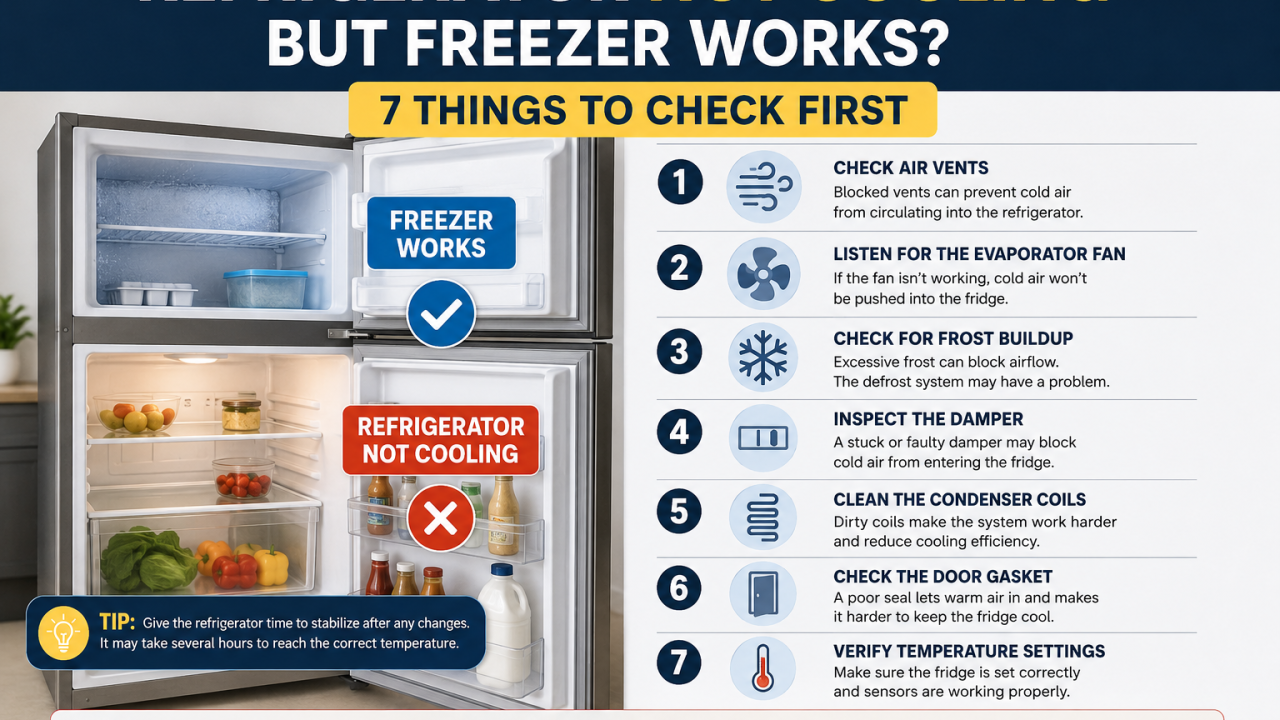
Refrigerator not cooling but freezer works? That symptom usually tells you something important: the appliance is still producing cold air, but the refrigerator compartment may not be receiving or retaining enough of it.
In many modern refrigerators, the freezer does much of the actual cooling. Cold air is then circulated into the fresh-food compartment through vents and fans.
That means a warm refrigerator combined with a cold freezer does not automatically point to a failed compressor.
The problem may instead be airflow.
Before scheduling a repair—or assuming you need a new refrigerator—work through the system in a logical order.
First, Confirm That the Refrigerator Is Actually Too Warm
Do not diagnose the appliance by touching a carton of milk or judging how cool the air feels when you open the door.
Use a refrigerator thermometer if you have one.
The U.S. Food and Drug Administration recommends keeping refrigerators at 40°F or below and freezers at 0°F.
If the fresh-food compartment is consistently above 40°F, you have a real cooling problem.
If it is close to the target temperature but simply feels warmer than expected, the appliance may be operating normally.
This distinction matters because refrigerators do not produce a constant stream of cold air. Cooling cycles start and stop based on temperature readings, door openings, ambient temperature and internal load.
Measure first.
Then troubleshoot.
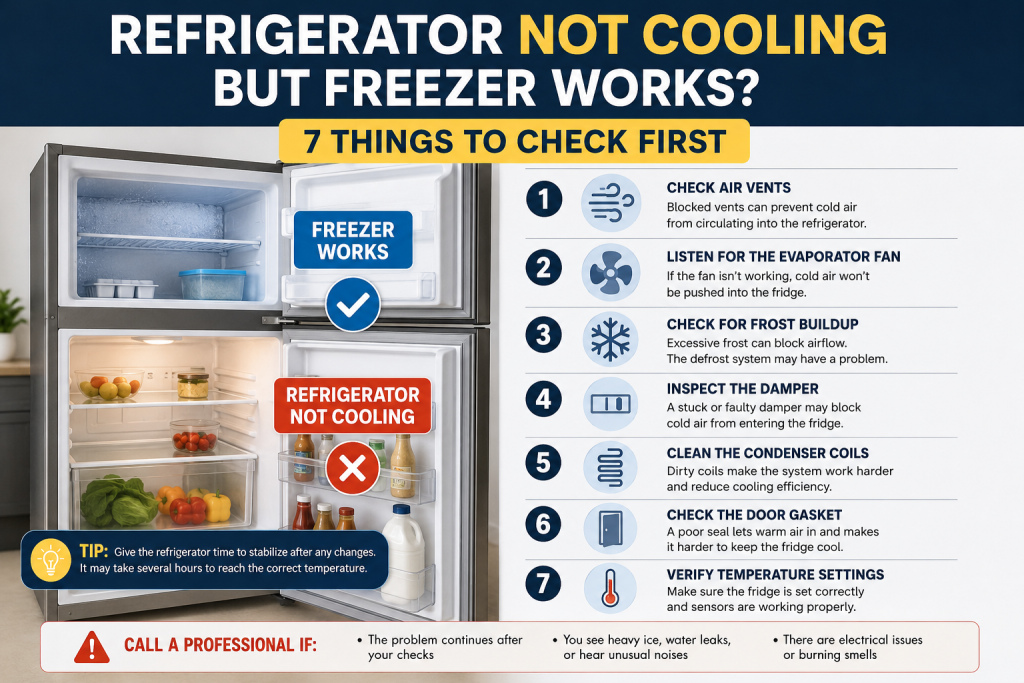
1. Check Whether the Air Vents Are Blocked
One of the simplest explanations is also one of the easiest to overlook.
Cold air must move from the freezer or evaporator area into the refrigerator compartment. If food containers, bags or large packages are pressed against the air vents, circulation can be restricted.
The freezer may remain perfectly cold while the refrigerator slowly warms.
Look along the rear wall and upper sections of the refrigerator compartment for air vents.
Move food several inches away from them.
Do the same inside the freezer, particularly around any visible intake or return vents.
A refrigerator packed tightly from wall to wall may also have difficulty circulating air evenly.
The goal is not to keep the refrigerator empty. It is to leave enough space for air to move around the food.
After correcting airflow, give the refrigerator time to stabilize before deciding the problem remains.
2. Listen for the Evaporator Fan
If your refrigerator uses an evaporator fan to move cold air, that fan becomes one of the most important components to consider.
The fan is typically located near the evaporator assembly in or behind the freezer compartment.
Its job is to circulate cold air across the evaporator coils and distribute that air through the appliance.
If the fan stops working, the freezer may remain cold near the coils while the refrigerator compartment receives little or no cold airflow.
Listen.
When the compressor is running, you may normally hear a soft fan sound from the freezer area.
If your refrigerator has a door switch that stops the fan when the freezer door opens, pressing that switch may allow you to check whether the fan starts.
Do not remove protective panels or reach into moving components unless you are qualified to do so safely.
A fan that is silent when it should be operating, makes grinding noises or repeatedly starts and stops deserves professional diagnosis.
The important point is that a failed circulation fan can create a warm refrigerator without requiring a failed cooling system.
3. Look for Heavy Frost on the Freezer’s Back Wall
Excessive frost is a major clue.
If the inside rear wall of the freezer is covered with thick frost or ice, cold air may be trapped behind an ice buildup instead of moving properly through the refrigerator.
That can happen when the automatic defrost system is not working correctly.
A typical frost-free refrigerator periodically warms the evaporator area enough to remove accumulated frost. Components involved may include a defrost heater, temperature sensor, thermostat, control board or timer depending on the model.
If part of that system fails, ice can gradually accumulate around the evaporator coil.
Initially, the freezer may still seem cold.
Eventually, however, airflow becomes restricted enough that the refrigerator compartment warms.
This is why the symptom can appear confusing: the appliance is technically producing cold temperatures, but the distribution system is being choked by ice.
Manually thawing the refrigerator may temporarily restore airflow, but if a defrost component has failed, the problem will return.
Treat repeated frost buildup as a fault to diagnose, not as a permanent solution you should manage with periodic thawing.
4. Check the Damper Between the Freezer and Refrigerator
Many refrigerators use a damper—or air diffuser—to regulate how much cold air enters the refrigerator compartment.
Think of it as a controlled doorway between the cold side of the appliance and the fresh-food section.
If the damper becomes stuck closed, damaged or blocked by ice, the freezer can remain cold while the refrigerator warms.
Locate the vent where cold air enters the refrigerator.
When the appliance is calling for cooling, you may be able to feel airflow coming through it.
Little or no airflow can point toward a blocked duct, frozen passage, fan problem or damper malfunction.
Do not force a plastic damper mechanism by hand. Small components can break easily, turning a diagnostic problem into an additional repair.
At this stage, the goal is simply to establish whether cold air is reaching the refrigerator compartment.
5. Inspect the Condenser Coils
Dirty condenser coils deserve attention even though they are not unique to the “freezer cold, refrigerator warm” symptom.
The condenser releases heat that the refrigerator removes from inside the cabinet.
Depending on the model, condenser coils may be located underneath the refrigerator, behind it or incorporated into a design that is less accessible.
When exposed coils become heavily covered with dust, pet hair and debris, heat transfer becomes less efficient.
The system may run longer and work harder to maintain temperature.
Before cleaning anything, unplug the refrigerator or follow the manufacturer’s safety instructions.
If the coils are accessible, use an appropriate vacuum attachment or coil-cleaning brush without bending or damaging the tubing.
Also inspect the area around the condenser fan if your model has one.
Cleaning heavily obstructed condenser coils is worthwhile maintenance, but maintain realistic expectations.
If the refrigerator suddenly became warm overnight while the freezer is still deeply cold, dusty coils alone may not be the entire explanation.
Think of coil condition as one part of the system diagnosis rather than an automatic answer.
6. Check the Door Gasket Before Replacing Anything Expensive
A refrigerator that cannot maintain a proper seal has to fight continuous warm-air infiltration.
Inspect the gasket around the refrigerator door.
Look for:
cracks,
torn sections,
areas pulling away from the door,
food residue preventing a clean seal,
or items inside the refrigerator preventing the door from fully closing.
Run your hand around the closed door and check whether any areas feel noticeably different.
You can also visually inspect whether the gasket is making consistent contact with the cabinet.
A gasket does not need to look destroyed to create trouble.
Even a small area that no longer seals correctly can introduce warm, humid air. That can increase compressor runtime and moisture accumulation.
Before ordering a replacement gasket, clean the existing one and make sure the refrigerator is level and the door is closing correctly.
A door overloaded with heavy bottles can sometimes sag enough to affect alignment.
7. Consider the Temperature Sensor or Control System
If airflow appears normal, frost is not excessive, the door seals correctly and the coils are reasonably clean, the problem may involve the refrigerator’s control system.
Modern refrigerators use thermistors or other sensors to measure compartment temperatures.
That information tells the control board when to run the compressor, fans and sometimes the damper.
A sensor that reports an incorrect temperature can cause the refrigerator to make poor cooling decisions.
A control board problem can create similar behavior.
These faults are more difficult to diagnose without model-specific testing procedures and electrical measurements.
This is usually the point where professional service becomes more rational than replacing parts based on guesswork.
A $30 sensor is inexpensive.
Replacing five inexpensive components one after another because no one actually diagnosed the failure is not.
What About the Refrigerator Temperature Setting?
Check it, but do not assume the setting explains everything.
Someone may have accidentally changed the refrigerator control. Children can bump controls. Items can press against internal buttons. A power interruption may also alter settings on some models.
Make sure the refrigerator and freezer controls are set within the manufacturer’s recommended range.
Then allow enough time for temperatures to stabilize.
Turning the refrigerator to its coldest possible setting is not a good diagnostic strategy.
If cold air is not reaching the refrigerator compartment, demanding more cooling may simply make the freezer colder while the underlying airflow problem remains.
What If the Freezer Is Too Cold?
An unusually cold freezer combined with a warm refrigerator can strengthen the case for an airflow or control problem.
Imagine the freezer sitting at -5°F while the refrigerator remains at 48°F.
The system clearly has cooling capacity.
The problem is that cooling is not being distributed or controlled correctly.
Possible suspects include:
a closed damper,
failed evaporator fan,
blocked air passage,
frost-covered evaporator,
or faulty temperature sensing.
That scenario is materially different from a refrigerator where both compartments are getting warmer.
If both the refrigerator and freezer are warm, the diagnostic tree changes. Compressor operation, condenser fan performance, refrigerant-system problems, power supply and other whole-system issues become more relevant.
When Should You Call an Appliance Repair Technician?
Professional diagnosis becomes reasonable when the simple checks do not reveal the problem.
Call for service if you find:
heavy frost that keeps returning,
a fan that does not operate normally,
no airflow from the refrigerator vents,
electrical or burning smells,
unusual clicking or grinding noises,
water near electrical components,
or temperatures that remain unsafe despite correcting obvious airflow issues.
You should also stop DIY troubleshooting if accessing the suspected component requires disassembling electrical or refrigerant-system components.
The sealed refrigeration system is not a practical DIY repair area for most homeowners.
How Much Repair Is Worth Putting Into an Older Refrigerator?
This is where troubleshooting becomes a financial decision.
A refrigerator can often be repaired.
That does not automatically mean it should be.
Suppose a technician identifies a relatively inexpensive fan motor in an otherwise reliable six-year-old refrigerator.
Repair is easy to justify.
Now suppose you have a significantly older refrigerator that has already required multiple repairs and the newest diagnosis involves a major sealed-system component or expensive electronic control.
The economic case changes.
Consider four variables:
Repair cost.
Age of the refrigerator.
History of previous failures.
Replacement cost for a comparable unit.
Do not compare the repair quote only with the sticker price of a new refrigerator.
Replacement can also involve delivery, installation, haul-away, water-line work and potentially cabinet-size constraints.
At the same time, do not keep paying for repairs merely because each individual invoice is cheaper than replacement.
Repeated repairs can turn an aging appliance into an expensive subscription.
Do Not Throw Away Food Based Only on How the Refrigerator Feels
Food safety deserves separate attention.
If the refrigerator has been above 40°F for an extended period, perishable food may no longer be safe.
FDA guidance states that refrigerated perishable food that has been above 40°F for four hours or more should generally be discarded.
Do not taste food to determine whether it is safe.
If you are uncertain how long the refrigerator has been warm, use a thermometer and make a conservative food-safety decision rather than relying on smell or appearance alone.
This is one reason a refrigerator thermometer is a useful low-cost household tool.
It turns a vague feeling that “the fridge seems warm” into an actual measurement.
A Better Troubleshooting Order
When the refrigerator is not cooling but freezer works, use this sequence:
First, measure the actual refrigerator temperature.
Then make sure food is not blocking the air vents.
Inspect for heavy frost.
Check whether cold air is entering the refrigerator compartment.
Listen for the evaporator fan.
Inspect the door gasket and verify the settings.
Check accessible condenser coils.
If none of those explain the problem, move toward professional diagnosis of the damper, fan motor, sensors, defrost system or control electronics.
That sequence matters because it starts with free observations before moving toward paid repair.
The Bottom Line
A refrigerator not cooling but freezer works situation does not automatically mean the refrigerator is finished.
In fact, the cold freezer tells you that some parts of the cooling system are still doing their job.
The most useful question is therefore:
Why is the cold air not reaching or maintaining the refrigerator compartment?
Blocked vents, frost buildup, a failed evaporator fan, a stuck damper, poor door sealing and control problems are all more targeted possibilities than immediately blaming the compressor.
Measure the temperature first.
Restore obvious airflow problems second.
Then decide whether the remaining fault is a sensible DIY maintenance task, a professional repair—or evidence that an aging refrigerator has reached the point where replacement is financially smarter.
Do not replace a $1,500 appliance before identifying the failed component.
But do not spend $800 rescuing an unreliable old refrigerator merely because it can technically be repaired.
The diagnosis should come first. The capital decision comes after it.