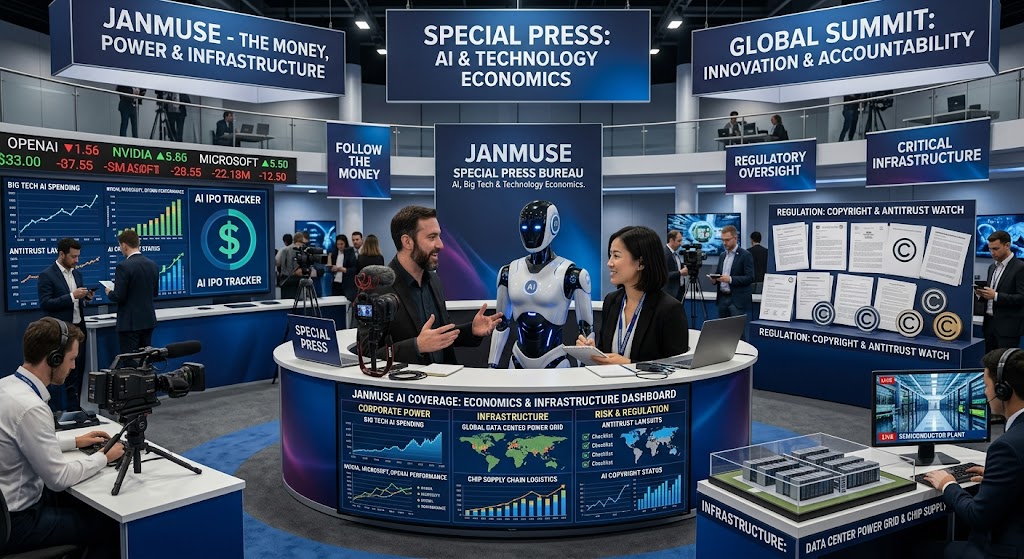
Across the American Landscape
Across the American landscape, a new industrial revolution is being etched into the earth. From the arid plains of Arizona to the cooling climates of the Pacific Northwest, massive server farms are rising with unprecedented speed. These are not merely buildings; they are the cathedrals of the digital age, sprawling footprints of steel and concrete designed to house the GPUs that power our artificial intelligence dreams. The sheer scale is staggering, with new data center pipelines expanding at a pace that suggests a limitless hunger for compute. Everywhere you look, the physical infrastructure of the internet is being rebuilt, expanded, and reinforced to support a future that promises total automation.
Investors have poured billions into this architecture, banking on the idea that if you build the capacity, the demand will follow. But as these monolithic structures loom larger on the horizon, a quiet tension is beginning to emerge. We are witnessing an unprecedented capital expenditure cycle, one that forces us to question whether the foundation being laid today is too heavy for the economic reality that lies ahead. The ground is shaking under the weight of this expansion, marking the first moment in a massive reassessment of what AI is actually worth to the global economy. The strategy dominating the tech sector is simple, yet incredibly risky: Land and Expand.
Across North America, major hyperscalers are securing vast tracts of land, not for the purpose of immediate utilization, but as a strategic stockpile for future growth. The objective is to claim the geography of the cloud before your competitors can. This race for territory has turned data center development into a game of attrition, where land rights, access to water, and proximity to regional power grids have become the most valuable real estate assets on the planet. It is an aggressive, forward-looking maneuver that assumes a linear, perpetual ascent in AI model performance and adoption.
However, this land-grab mentality is now bumping against the harsh realities of physical space and municipal capacity. Communities are beginning to push back against the sheer resource footprint of these facilities, creating a friction point that wasn’t in the original pitch decks of venture capitalists. As companies scramble to satisfy the insatiable hunger of their LLMs, the map of North America is being redrawn. We are seeing a divergence between the software aspirations of Silicon Valley and the physical limitations of the continent, a disconnect that is starting to make investors nervous about the long-term sustainability of this build-out.
Beneath the Polished Surfaces of These New Facilities Lies a Mounting Energy Crisis
Beneath the polished surfaces of these new facilities lies a mounting energy crisis. The data center power consumption market is currently navigating a staggering compound annual growth rate of 27. 3 percent. This number is not just a statistic; it is a siren song warning that the current trajectory of AI development is running out of juice. To feed the massive compute clusters, we are essentially demanding that the power grid perform a miracle of consistent, reliable delivery. Every rack of GPUs added to a data center requires exponential increases in cooling and electricity, turning these tech hubs into some of the most energy-intensive sites in history. The 27.
3 percent figure represents a structural challenge that threatens to turn the AI dream into a high-cost burden. While AI developers focus on parameter counts and training cycles, the physical reality is that there is only so much electricity available in any given region. When the demand for power outpaces the deployment of sustainable or even conventional energy, the economic unit of every token generated becomes increasingly expensive. We are finding that the cost of existence for AI models is far higher than anyone initially calculated, creating a bottleneck that can no longer be ignored by the boardrooms of the tech giants.
We are reaching a turning point where physical infrastructure is no longer a silent partner in the AI boom—it has become the primary bottleneck. For years, the narrative was that software would always be the driver of innovation, and hardware would simply scale to meet it. That paradigm is now breaking. Developers are finding that their ability to scale intelligence is being throttled by the physical speed at which transformers and substations can be installed. This is the ‘valuation-reality squeeze’: the software is ready to grow, but the physical world is holding it back. It is an infrastructure wall.
The delays in permitting, the lead times on specialized hardware, and the sheer environmental impact are creating a drag on the deployment of next-generation AI agents. For investors, this is a wake-up call. The value of an AI company is increasingly tied to its ability to secure power and space, rather than just its algorithm. This shift from a digital-only narrative to a heavy-asset reality has fundamentally changed the risk profile of the sector. The bottleneck isn’t just silicon; it is the physical world itself, and overcoming it is proving to be far more expensive and time-consuming than the industry ever anticipated. The shock was palpable.
When OpenAI’s projected revenue figures for the year were revealed, the market did not respond with the usual excitement—it reacted with profound concern.
With a Target Figure Set High
With a target figure set high, missing that mark by an eye-watering 20 billion dollars sent a clear message to the broader AI trade. How does a company at the center of the world’s most hyped technological shift miss its revenue targets by such a wide margin? This isn’t a rounding error; it is a fundamental miscalculation of the speed at which enterprise and consumer adoption could convert into hard cash. The 50 billion dollar revenue figure was a symbol of the trillion-dollar thesis, a promise that the utility of generative AI would pay for the massive build-out of infrastructure.
By failing to hit that target, the industry exposed the gap between the perceived value of artificial intelligence and its current ability to generate actual, sustainable revenue. Investors who had bought into the ‘hockey stick’ growth charts of the AI revolution are now staring at a much flatter curve, one that implies the monetization of these models is significantly harder than the hype suggested. For years, the industry lived by the gospel of exponential AI revenue growth. The assumption was that intelligence would be a commoditized utility, consumed at scale by every business on earth. But we are now seeing the reality of the adoption cycle.
Complex, high-cost models are struggling to find a clear path to profitability that justifies the astronomical costs of inference and maintenance. The models are getting better, but the revenue isn’t necessarily following in tandem. When the previous models of growth are put under fire, it forces a reckoning with the fundamental unit economics of the business. Are we charging enough for these services? Is the market actually interested in the level of AI complexity we are building? The current skepticism is a direct result of that disconnect. We are seeing a pivot from a period of ‘growth at all costs’ to a period of ‘performance at any cost.
‘ Analysts are now scrutinizing the revenue-per-GPU-hour, looking for evidence that these systems are providing real-world productivity gains that can be sold. The golden age of speculative investment is cooling, replaced by a colder, harder look at the bottom line. The question is no longer how fast we can grow, but how efficiently we can make money. The contagion of doubt has spread quickly, and it is now affecting even the most revered names in the AI space. Investors are reportedly weighing a much lower valuation for Anthropic—a figure potentially closer to 1. 5 trillion dollars than the ambitious targets once whispered in the halls of Silicon Valley.
This isn’t just about a single company; it is about a sector-wide revaluation. As the revenue growth of these leading labs begins to slow or plateau, the multiples that investors are willing to pay are contracting sharply. The ‘trillion-dollar thesis’ is being tested as the market realizes that AI labs are not immune to the laws of supply and demand, nor are they immune to the realities of market saturation.
For Anthropic, This Shift Represents a High-stakes Moment
For Anthropic, this shift represents a high-stakes moment. Their ability to deliver on their promise is being weighed against the slowing growth of the entire sector. Investors are no longer content with promises of future intelligence; they are demanding proof of current revenue growth and a clear path to profitability. The downward pressure on these valuations is a symptom of a broader, deeper concern about the economic feasibility of the current AI boom. The push for transparency has become the loudest noise in the industry. As Anthropic prepares to share its third-quarter financials, the entire tech sector is holding its breath.
This data will serve as a bellwether for the health of the entire generative AI market. Investors are looking for concrete numbers—revenue, burn rates, and customer acquisition costs—that can either confirm the hype or justify the current skepticism. The era of ‘black box’ financials, where visionaries could command massive capital based solely on the promise of future AI capabilities, is drawing to a close. We are entering a phase where the market expects the same level of accountability from AI labs that it expects from every other sector in the economy. This upcoming financial disclosure is more than just a reporting requirement; it is a test of confidence.
If the numbers align with the potential, the trillion-dollar thesis may survive. If they disappoint, we are likely to see a significant, and perhaps painful, correction in the valuations of the most prominent players. The market is tired of the abstract; it wants to see the balance sheet, and in that demand for transparency, we find the real end of the early, speculative phase of the AI revolution. The cooling sentiment surrounding AI valuations is not merely a product of market whims; it is directly tethered to the staggering friction between software potential and physical infrastructure costs.
While the industry promised a revolution in productivity, the underlying engine of that revolution requires an increasingly prohibitive amount of capital. We have arrived at a point where every incremental increase in model capability requires an exponential surge in data center capacity. This creates a revenue squeeze where the costs of training and inference are outpacing the revenue generated by early enterprise deployments. Investors who once funded this ‘build at any cost’ mentality are now forced to confront the reality that the infrastructure layer is not a bottomless resource.
Every training cluster brought online demands massive utility investments, specialized cooling, and long-term energy commitments that tighten the pipeline for new software deployments.
As Capital Expenditure Ambitions Collide with These Physical Hard Caps
As capital expenditure ambitions collide with these physical hard caps, the promised margin expansion for AI software starts to look more like a long-term utility burden. The connection between current revenue slowdowns and the sheer price of keeping the lights on in the server room is becoming the central narrative in the boardroom, turning the focus from pure generative speed toward the harsh, cold metrics of infrastructure cost-to-revenue ratios. Investors are pivoting with clinical precision, shifting their gaze away from growth-at-all-costs metrics toward a focus on fundamental unit economic efficiency.
This is a critical transition; when valuation multiples reach into the trillions, the market no longer accepts promises of future scale. Instead, shareholders are demanding to know the actual cost of a single query, the customer acquisition cost of a seat, and the lifecycle longevity of an enterprise subscription. The era of focusing on model parameters or total training compute—the vanity metrics of 2024 and 2025—is effectively over. Now, the discussion has migrated to the granularity of profit per token.
The shift is palpable: if an AI lab must burn through hundreds of millions in infrastructure to realize a single dollar of software revenue, that business model is fundamentally unsustainable at scale. This re-evaluation is not a sign of the industry failing, but of it maturing into a sector that must eventually be judged by standard GAAP principles. As venture and institutional capital becomes more discerning, the pressure is mounting on these labs to demonstrate that their revenue streams can eventually decouple from the current reliance on constant, massive hardware infusions. The efficiency of the unit is now the primary determinant of valuation viability.
Beyond the balance sheets, there is a physical reality that software developers are only now beginning to reconcile with: the power grid is not an infinite battery. Across North America, the massive data center pipeline is hitting a hard ceiling defined by electrical connectivity and grid reliability. Building a state-of-the-art training cluster has moved from a challenge of procuring GPUs to a complex, multi-year struggle to secure megawatt capacity from local power providers. This power constraint is the invisible handbrake on software deployment.
Even if a lab has the capital to purchase thousands of chips, they often find themselves waiting months, or even years, for the transmission infrastructure to catch up to their demand. We are seeing a mismatch in timelines that is beginning to bleed into financial disclosures. When a company projects revenue based on the rapid rollout of new models, it often assumes a seamless ability to scale up its compute power. Yet, the physical environment of our power infrastructure is simply not moving at the same pace as software engineering.
This Lag Is Creating a Bottleneck Where Promised Products Are Delayed
This lag is creating a bottleneck where promised products are delayed, revenue realization is pushed out, and the optimistic growth targets of early funding rounds are becoming increasingly difficult to meet in the physical world. The macro view of the industry reveals a fundamental divergence between capital expenditure ambitions and the actual capacity of global infrastructure. We are caught in a cycle where the appetite for massive AI models necessitates building data centers at a rate that the physical supply chain and energy grids were never designed to support. This is no longer a localized issue; it is a systemic friction that defines the current AI trade.
The market is waking up to the realization that infrastructure is not merely a tool for AI, but the primary limiting factor of its existence. When you examine the market size—growing at a CAGR of over 27 percent—it becomes clear that this is an unsustainable expansion if not met with corresponding breakthroughs in power distribution and energy production. The capital expenditures of the major AI labs are currently outpacing the development of the power infrastructure required to support them.
This creates a structural risk that investors are beginning to price in: a scenario where the ‘Trillion-Dollar Thesis’ is hampered by the inability to move electrons as fast as we move data. As supply chain constraints meet the reality of grid limitations, the entire industry is being forced to accept that the road to super-intelligence is paved with, and limited by, very tangible, very scarce materials. Institutional investors are no longer content with projections that exist in a vacuum; they are systematically deconstructing the revenue foundations of the industry’s largest players.
The recent revelation that OpenAI’s revenue figures missed earlier projections by tens of billions has sent a shockwave through the financial sector. This is not just a rounding error; it is a fundamental shift in how the market values the ‘intelligence’ sector. When a company with such immense prestige and capital access misses revenue targets by such a wide margin, the valuation models that were built on the promise of exponential growth start to look brittle. Analysts are now stripping away the narrative of ‘transformative potential’ to look at the hard, realized revenue that actually hits the accounts.
This re-evaluation is causing a ripple effect across the entire ecosystem, forcing even private equity and sovereign wealth funds to reassess their risk profiles. The question is no longer ‘how fast can you grow? ‘ but ‘how much of your current revenue is actually defensible, recurring, and profitable? ‘ As the models are updated to reflect these realities, the valuation gap between the hyped potential and the realized fiscal outcome is narrowing, causing significant volatility in the sentiment of the most prominent players.
A pervasive sense of caution has taken hold of the market, driven by the stark disconnect between pre-IPO expectations and the cold, hard revenue actuals being reported by AI labs.
Anthropic’s Current Valuation Discussions
Anthropic’s current valuation discussions, which are hovering around the trillion-dollar mark, are being met with significant skepticism as the company prepares to share its third-quarter financials. Investors have seen this movie before in other tech cycles: the valuation is a reflection of the ‘if,’ but the revenue is a reflection of the ‘is. ‘ The market is currently weighing these two figures against each other, and the tension is palpable. If the actual revenue growth does not track with the aggressive valuation, we are likely to see a significant recalibration. This is a moment of truth for the sector.
The market is demanding transparency because the blind trust of the early days has been exhausted. As labs like Anthropic and OpenAI invite deeper scrutiny, they are testing whether their business models can withstand the glare of public or semi-public financial accountability. For the AI trade, the days of coasting on the momentum of potential are ending; the days of performing under the scrutiny of realized earnings are just beginning. Behind closed doors, a quiet but intense internal struggle is playing out at companies like OpenAI and Anthropic, pitting technical perfectionism against the relentless pressure of revenue goals.
Engineers and scientists, who for years were given a blank check to pursue the scaling laws of intelligence, now find themselves working under the constraints of commercialization. This is not a simple friction; it is a fundamental fork in the road for these organizations. They are attempting to reconcile the massive, multi-billion-dollar costs of training the next generation of frontier models with the need to build a business that can actually generate a return. The leadership at these firms is caught in a vice: if they slow down development to focus on profitability, they risk losing the technical edge that defines their value proposition.
If they continue to spend aggressively on compute without a clear path to revenue, they risk losing the support of their investors. This internal battle is the defining character of the current phase of the AI industry. It is a transition from an academic, research-led organization into a commercial, product-focused entity that must deliver on the promise of its technology while operating within the rigid boundaries of fiscal reality. The evolution of competition is perhaps the most telling sign of this new era: the battleground is shifting from who has the largest model to who has the most capital-efficient architecture.
Differentiation Is No Longer Solely About Parameter Counts
Differentiation is no longer solely about parameter counts; it is about the ability to deliver high-quality intelligence at a cost that makes economic sense for the end user. This pivot toward capital efficiency is a direct response to the pressures of the infrastructure squeeze we have witnessed. Companies that can optimize their inference costs, streamline their data ingestion, and maximize the utility of every compute cycle are beginning to emerge as the leaders of the next generation of the AI market. This represents a mature phase in the development of the technology.
As the hype cycles settle, the labs that will survive are not necessarily the ones that built the biggest model first, but the ones that built the most sustainable business around their innovations. The competition has transitioned from a race of raw, brute-force scaling to a more sophisticated, disciplined race for efficiency and value. This is the moment when the trillion-dollar thesis is being stress-tested, and it is the companies that can bridge the gap between technical brilliance and financial sustainability that will define the future of the artificial intelligence landscape.
We are currently living through a period of stark realization, a ‘valuation-reality squeeze’ where the atmospheric projections of the AI boom meet the hard, jagged edges of industrial capacity. For years, the thesis was simple: spend billions on compute, gain intelligence, and unlock trillions in market value. But as we look at the 2026 data landscape, that equation is fracturing. Data center pipelines are struggling to keep pace with the voracious power demands of modern large-scale models, which are now seeing power consumption growth rates approaching a 27. 3% CAGR.
This is not merely a supply chain bottleneck; it is a fundamental collision between the speed of software innovation and the physical limitations of electrical grids and server density. Investors are beginning to recognize that when the infrastructure itself becomes a bottleneck to scaling, the software layer cannot simply outrun its physical support system. We are witnessing a transition from a speculative ‘land grab’ phase of development to a more disciplined, resource-conscious environment where every kilowatt-hour of power and every megawatt of cooling capacity carries a direct, unavoidable cost that must be justified by immediate revenue realization, rather than just the promise of future ubiquity.
The fragility of the trillion-dollar thesis is nowhere more apparent than in the revenue reports emanating from the giants of the sector. When OpenAI recently missed its revenue projections by a staggering twenty billion dollars, the market reaction was immediate and visceral. It was a signal that the gap between projected model performance and actual enterprise adoption is wider than previously calculated. This is not a failure of innovation, but a reality check on the monetization timeline.
They Are Scrutinizing the Unit Economics
Similarly, as the industry observes the shifting valuation models for companies like Anthropic, we see a direct correlation between revenue growth deceleration and the tempering of market expectations. Investors are no longer valuing these firms solely on parameter counts or potential capabilities; they are scrutinizing the unit economics—how much it costs to serve a query versus how much a corporate client is willing to pay. This re-evaluation serves as a structural pivot. The narrative of infinite growth is being replaced by the necessity of operational rigor.
Physical buildout costs, which remain stubbornly high, must be amortized over a revenue base that is proving harder to grow at hyper-scale than the optimistic models of 2024 and 2025 predicted. We have reached an inflection point where the industry must mature or risk a prolonged period of stagnant valuation. The transition from the ‘build at all costs’ model to one defined by sustainable unit economics is not a retreat; it is the natural maturation of an enterprise technology cycle.
For AI labs to hold their multi-trillion-dollar valuations, they must prove that their infrastructure investments are generative in the truest sense—producing tangible cash flow that outpaces the compounding costs of power, cooling, and high-end silicon. This requires a shift in focus toward architectural efficiency, where the goal is no longer just the biggest model, but the most economically viable one. This cycle demands that developers and executives alike account for the true cost of intelligence. When we strip away the abstraction of cloud compute, we are left with power, water, and specialized labor. If these input costs cannot be managed within a sustainable margin, the software itself becomes a liability.
Moving forward, the winners will be determined by their ability to achieve ‘revenue-led scale’ rather than ‘compute-led scale,’ marking a more disciplined era in the history of artificial intelligence development. Looking ahead, the market is bracing for a fundamental reset, not of the technology’s potential, but of the financial framework surrounding it. The era of blind capital infusion is giving way to a more discerning epoch of investment, where the ‘trillion-dollar thesis’ is pressure-tested against the reality of physical buildout pipelines and slowing revenue growth.
This isn’t a sign that AI has reached its limits, but rather that it has graduated from the novelty phase into the grueling work of industrialization. As firms like Anthropic and OpenAI navigate their own internal revenue forks, they are setting the precedent for the broader ecosystem. The long-term outlook for the sector is fundamentally tied to its ability to prove that its value exceeds the massive, ongoing cost of its physical infrastructure. Those who can balance these two spheres—the digital innovation and the physical requirement—will lead the next generation of the global economy.
Ultimately, the future of the artificial intelligence landscape will be defined by its ability to turn the friction of the present into the, at times, quiet efficiency of a stable, profitable, and truly transformative industry that has learned how to pay its own way.