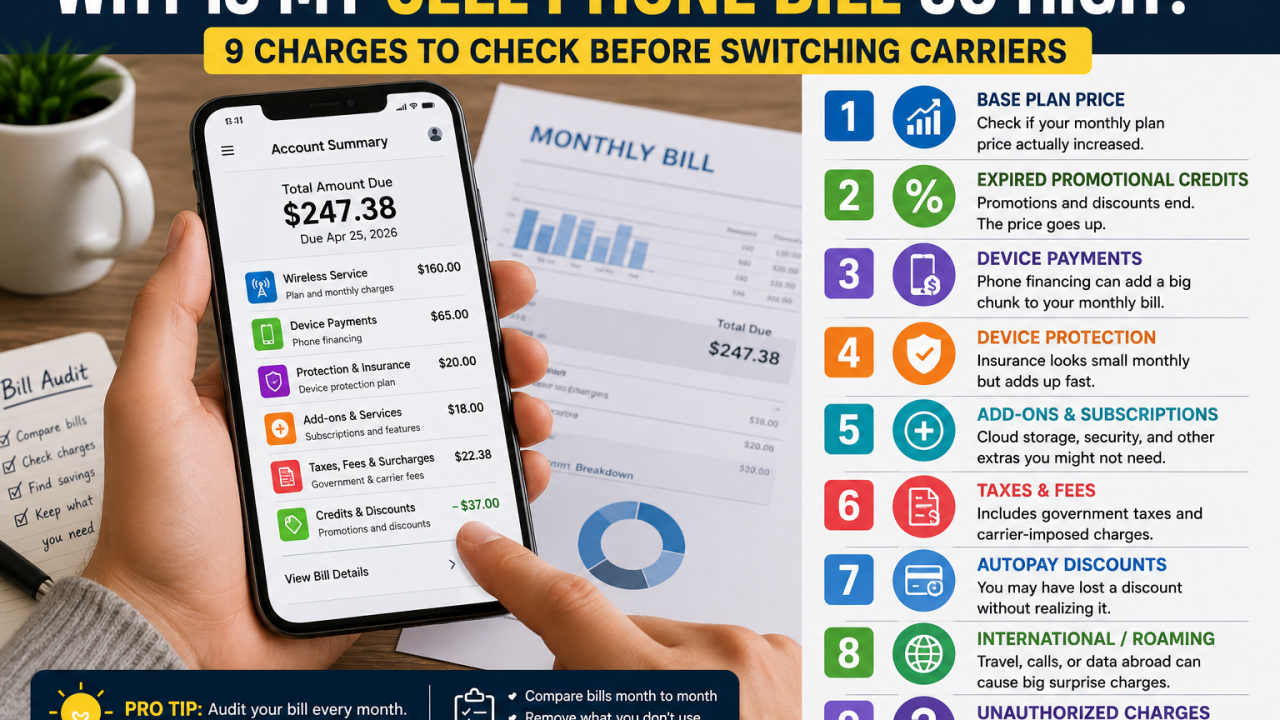
Why is my cell phone bill so high? Before blaming your wireless carrier’s advertised plan price, compare your current bill with the previous one line by line.
The number at the bottom of the bill is only the output.
What matters is what changed underneath it.
A household’s wireless bill can increase even when nobody intentionally changes the core phone plan. A device promotion can end. A monthly credit can disappear. Insurance can be added to a new phone. An international call can create an unexpected charge. A financing payment can begin. An autopay discount can disappear.
And sometimes the charge should not be there at all.
The Federal Communications Commission’s Truth-in-Billing rules are designed to make telephone bills understandable and help consumers identify unauthorized charges. The FCC says bills should contain clear, factual descriptions of the services being billed.
That gives you a useful starting point:
Do not ask whether your phone bill is expensive until you know exactly what you are paying for.
Here are the nine areas to check first.
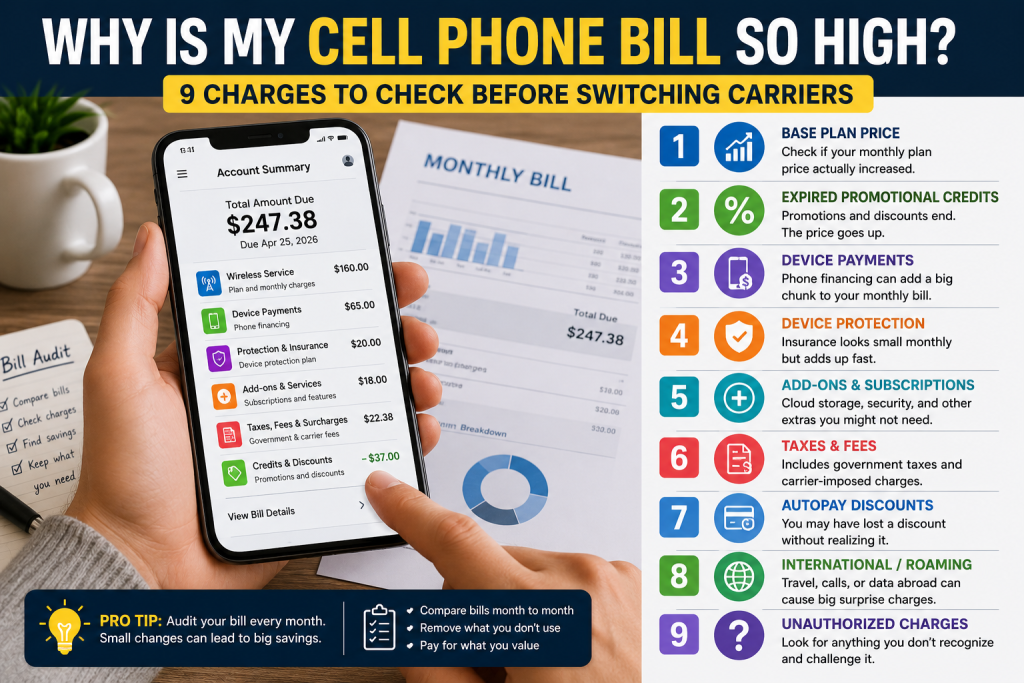
1. Find Out Whether Your Base Plan Actually Increased
Start with the recurring charge for wireless service itself.
Ignore the total bill for a moment.
Compare the base service charge on your current bill with the previous month and, if possible, with a bill from six or twelve months ago.
You are trying to answer a specific question:
Did the price of the service plan increase, or did something else increase the bill?
Suppose a family pays $160 for wireless service and the final bill rises from $205 to $247.
It would be easy to conclude that the carrier raised the plan by $42.
But if the service line still says $160, switching plans may not solve the real problem.
The additional $42 could be sitting somewhere else.
This distinction becomes especially important when comparing carriers because advertised plan prices rarely represent every dollar flowing through an existing household account.
Separate the bill into four buckets:
Wireless service
Devices
Optional products and services
Taxes, surcharges and other charges
Then compare each bucket over time.
That is much more useful than comparing only the total.
2. Check Whether a Promotional Credit Expired
One of the easiest increases to miss is not technically a new charge.
It is the disappearance of an old credit.
Wireless promotions frequently influence what consumers perceive as the normal monthly price.
Perhaps you received a promotional service discount.
Maybe a trade-in offer generated monthly device credits.
Maybe adding a line created a temporary discount.
If a $20 monthly credit disappears, the bill rises by $20 even though no new $20 charge appears.
This creates an important psychological trap.
Consumers tend to scan bills for something that was added.
Sometimes they should be looking for something that was removed.
Compare the credits and discounts sections of consecutive bills.
If the bill increased by $25, search specifically for a previous $25 credit.
Then determine why it disappeared.
Was the promotional period completed?
Did an account change make the line ineligible?
Did you pay off or replace a device?
Was there a billing error?
Do not immediately switch carriers before understanding this.
If the missing discount resulted from an error, the cheapest solution may be correcting the account rather than moving the entire household to a new provider.
3. Separate Your Phone Payment From Your Wireless Service
Many consumers mentally combine the cost of the phone and the cost of the network.
Financially, they are different.
If you financed an $800 or $1,000 smartphone through your carrier, part of your monthly wireless bill may actually be an installment payment on that device.
Multiply this across several family members and device financing can become a significant percentage of the monthly total.
That means a household comparing a $240 current bill with a competitor’s “$120 plan” may not actually be comparing equivalent costs.
The $240 bill might contain:
$140 of wireless service,
$65 of phone installments,
$20 of device protection,
and $15 of taxes and other charges.
Switching to a $120 service plan would not magically eliminate the remaining balance owed on the phones.
Before evaluating another carrier, calculate what JanMuse calls your service-only cost.
Take the total bill and remove:
device installment payments,
device insurance,
accessory financing,
one-time charges,
and unrelated add-ons.
Now compare the remaining recurring wireless service cost with alternatives.
That is the number that matters.
4. Look for Device Protection You No Longer Need
Device protection can quietly become a permanent household expense.
One protected phone may not look expensive on the monthly bill.
Multiply the cost across three, four or five lines and annual spending becomes more meaningful.
For example, even $15 per month across four devices equals:
$60 per month
or
$720 per year.
That does not automatically make insurance a bad purchase.
The decision depends on the value of the device, deductible, coverage terms, household cash reserves, likelihood of damage and how long you intend to keep the phone.
But it should be an intentional purchase.
Ask three questions for each insured device:
How much would it cost to replace this phone today?
What deductible would I pay if I filed a claim?
How much will I spend on protection over the next 12 months?
A two-year-old phone that could be replaced with a reasonably priced refurbished device presents a different insurance decision from a newly purchased flagship smartphone.
Also check whether protection was added during an upgrade and simply forgotten.
Do not cancel coverage without reviewing the terms.
But do not continue paying indefinitely merely because the monthly amount looks small.
Annualize it.
Small monthly charges become much easier to evaluate when expressed as yearly spending.
5. Audit Every Optional Add-On
Modern wireless accounts can contain much more than phone service.
Depending on the provider and account, consumers may encounter optional services involving cloud storage, security tools, international features, connected devices, entertainment products or other subscription-style benefits.
Some may be useful.
Others may survive for years because nobody remembers adding them.
Review every recurring line item that is not necessary to keep the phone connected.
For each one, ask:
Would I buy this service today if it were not already on the bill?
If the answer is no, investigate whether it can be removed.
This is one of the best rules for subscription spending generally.
Do not ask whether an add-on is “only $5.”
Ask whether it produces at least $60 of value per year.
A household with four or five small telecommunications add-ons can easily spend hundreds of dollars annually without consciously making a single large purchase.
6. Check Taxes, Surcharges and Carrier-Imposed Fees Separately
The bottom portion of a phone bill can be confusing because not every charge that sounds governmental is necessarily the same type of charge.
Telephone bills can include government taxes and assessments as well as other surcharges and provider-related charges. FCC billing guidance is intended to help consumers understand what they are being charged for rather than treating the entire amount below the service price as one undifferentiated block.
The practical lesson is simple:
Do not assume every fee is a tax that cannot be questioned.
Open the detailed bill.
Identify which charges are taxes or government assessments and which are provider-imposed charges or surcharges.
Then compare those amounts with the previous month.
If one category increased materially, search the provider’s explanation or contact customer service and ask specifically what changed.
A useful question is:
“Which portion of this charge is government-imposed, and which portion is set by the company?”
That question is much more productive than asking why the entire bill is expensive.
7. Check Whether You Lost an Autopay or Paperless Billing Discount
A billing-method discount is another example of a bill increase that may not appear as a new charge.
The credit simply disappears.
This can happen after:
a payment method changes,
a credit or debit card expires,
autopay is turned off,
an account becomes temporarily delinquent,
or eligibility rules for the discount change.
If the monthly difference is suspiciously consistent—$5, $10 or another round amount per line—compare previous bill credits with the current statement.
On a multi-line family account, a relatively small per-line change can become meaningful.
For example, a $5 lost discount across five lines is:
$25 per month
or
$300 per year.
Do not change your payment method solely to obtain a discount without considering security, cash-flow and payment preferences.
But understand what the convenience decision is costing you.
8. Look for International Calls, Travel or Roaming Charges
Unexpected international usage can create a very different type of bill increase.
The FCC has historically described “bill shock” as an unexpectedly large increase that can arise from issues including roaming or unexpected usage-related charges.
If someone in the household recently traveled internationally, called another country or changed travel settings on a device, inspect that section carefully.
Do not assume that using your phone abroad works exactly like using it at home.
International pricing can depend on the carrier, destination, plan, travel feature and type of usage.
Before future travel, verify:
whether your domestic plan includes the destination,
what happens when the phone connects to a foreign network,
whether an international travel option needs to be activated,
and how voice, text and data are priced.
Also review each family member’s usage.
One person’s trip can affect the entire account bill.
If an international charge appears incorrect, contact the provider and identify the exact date, line and usage event you are disputing rather than simply asking for the bill to be reduced.
9. Look for Charges You Never Authorized
This is the category you should treat differently from ordinary cost optimization.
The FCC defines cramming as unauthorized charges placed on a telephone bill. Its current complaint system specifically distinguishes cramming from ordinary billing disputes.
That means an unfamiliar charge should not automatically be dismissed as another annoying fee.
Ask:
Do I recognize the company?
Did anyone on the account authorize this service?
When did the charge begin?
Is it recurring?
Does it appear on previous bills?
If you cannot identify it, contact the provider and dispute the charge.
Keep copies of bills and records of the conversation.
If the problem cannot be resolved, the FCC Consumer Inquiries and Complaints Center accepts complaints involving phone billing and related consumer issues.
The financial lesson is straightforward:
Cost cutting means eliminating charges you do not value. Consumer protection means challenging charges you never authorized.
Those are not the same thing.
The Most Important Number Is Cost Per Line
Multi-line family plans make bills psychologically difficult to evaluate.
A $220 bill sounds expensive.
But the number becomes more useful when decomposed.
Suppose the household has four lines.
At first glance:
$220 ÷ 4 = $55 per line.
But imagine that $48 of the bill consists of device financing and $24 consists of insurance.
The actual recurring wireless service component is:
$148 ÷ 4 = $37 per line.
That changes the switching decision substantially.
A competitor offering “$35 per line” may produce almost no meaningful service savings once you compare equivalent costs.
Conversely, if your service-only cost is actually $65 per line, competitive alternatives may deserve serious investigation.
Always normalize the bill before comparing providers.
Before Switching Carriers, Calculate the Real Savings
Switching providers can save money.
But the headline promotional price is not the decision variable.
Calculate:
Current service-only monthly cost
minus
Expected new service-only monthly cost
Then subtract or account for:
remaining device balances,
activation or setup costs,
new phone requirements,
loss of existing promotional credits,
differences in taxes and fees,
insurance changes,
and any temporary promotional pricing.
For example, imagine a new provider appears to save $50 per month.
That looks like:
$600 per year.
But suppose switching requires $300 of net transition costs.
Your first-year savings are closer to:
$300.
That may still be worthwhile.
But it is not the same decision.
This is particularly important when an existing phone is still financed.
A cheap wireless plan does not erase a device obligation.
Coverage Is Part of the Economics
The cheapest wireless plan is not automatically the lowest-cost plan.
If coverage is poor where you live, work or travel, you may pay for a service that does not reliably perform its primary job.
Do not evaluate carriers based only on nationwide advertising.
Evaluate them based on your actual geography.
Before switching, investigate coverage at:
your home,
your workplace,
your commute,
frequently visited family locations,
and regular travel destinations.
Ask people who actually use the network in those areas.
Price optimization without service-quality validation can create false savings.
Saving $20 per month is not an economic win if you later need a second solution because the first service is unreliable.
You May Not Need a New Phone to Switch
Consumers sometimes assume changing carriers requires purchasing another device.
That is not necessarily true.
The FCC explains that an unlocked phone may be used when moving between compatible wireless networks, subject to technical compatibility and the device’s eligibility for unlocking.
This matters because keeping an existing paid-off phone can dramatically improve switching economics.
A plan that saves $30 per month is much less attractive if switching persuades you to buy a $1,000 phone you did not otherwise need.
Separate the network decision from the device decision.
You are choosing:
Who provides my wireless service?
and independently:
Do I actually need another phone?
Carriers often combine those decisions commercially.
Your household budget does not need to.
You Can Generally Keep Your Number When Switching Providers
Fear of losing an established phone number should not automatically prevent consumers from comparing providers.
The FCC states that consumers switching providers while remaining in the same geographic area can generally keep their existing phone number through number porting.
Do not cancel the old service prematurely if you intend to port the number.
Follow the new provider’s porting process and verify what information is required from the existing account.
The operational sequence matters.
Saving money on wireless service is useful.
Accidentally disrupting a number tied to banking, work, authentication or years of personal contacts is not.
When Should You Stay With Your Current Carrier?
Staying can make sense when the problem is not actually the carrier’s recurring service price.
For example:
a promotional credit was mistakenly removed,
an optional service can simply be canceled,
you are near the end of expensive device payments,
the current plan has excellent local coverage,
or the competing offer produces very little savings after normalizing all costs.
Sometimes the best negotiation happens after you have already understood the bill.
Do not call customer service and ask:
“Can you make my bill cheaper?”
Call with specific requests:
“I no longer need this device protection.”
“Why did this credit disappear?”
“What would the recurring service cost be if I removed this add-on?”
“Do you have a current plan with equivalent features at a lower monthly cost?”
“What will my bill be after these device installments end?”
Specific questions produce actionable answers.
When Does Switching Make Sense?
Switching becomes more compelling when several conditions exist simultaneously.
Your service-only cost is materially above competitive alternatives.
The new provider offers acceptable coverage.
You can keep your current devices or replace them economically.
You understand any remaining device obligations.
The savings remain meaningful after promotional pricing ends.
And the transition costs have a reasonably short payback period.
JanMuse’s preferred metric is simple:
Switching Payback Period = One-Time Switching Costs ÷ Monthly Recurring Savings
Suppose switching costs you $180 but reduces recurring expenses by $45 per month.
Your payback period is:
$180 ÷ $45 = 4 months.
After that, the recurring savings begin producing a genuine household benefit.
Now compare that with paying $600 to switch plans for a $15 monthly saving.
The payback period is:
40 months.
That is a much weaker financial proposition.
Do the math before reacting to the promotion.
The 15-Minute Cell Phone Bill Audit
If your bill feels too high, do not spend an afternoon researching every wireless provider in America.
Open your current bill and the previous bill.
Then identify:
your total recurring service cost,
device installment payments,
device protection,
optional add-ons,
taxes and surcharges,
discounts and credits,
international charges,
one-time charges,
and anything you do not recognize.
Circle every number that changed.
The explanation for the higher bill is usually hiding inside that comparison.
Only after completing that audit should you begin shopping.
Otherwise, you risk solving a $15 insurance problem with a complete carrier migration.
The Bottom Line
If you are asking “why is my cell phone bill so high?”, do not start by searching for another carrier.
Start by decomposing the bill.
Determine whether the increase came from the wireless plan itself, a disappearing promotional credit, device financing, insurance, optional services, fees, lost discounts, international usage or an unauthorized charge.
Then calculate your service-only cost per line.
That number tells you whether your existing carrier is genuinely expensive or whether your bill is being inflated by costs that switching providers may not eliminate.
Cancel what you do not value.
Challenge what you did not authorize.
Pay attention to device financing.
Compare equivalent service rather than promotional headlines.
And switch only when the recurring savings remain attractive after coverage, devices and transition costs are included.
The objective is not to have the cheapest-looking phone plan.
It is to minimize the total cost of reliable mobile service for your household.
Sources
This guide uses Federal Communications Commission consumer guidance covering Truth-in-Billing requirements, telephone billing disputes, unauthorized charges, international bill shock, cell phone unlocking and number portability.